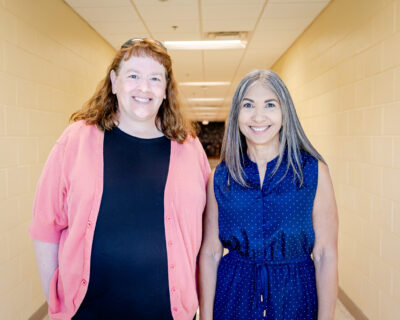
HRA science teachers Marcy Ouellette and Dr. Maribel Gendreau, authors of the innovative “Growing Futures” curriculum
According to Ben Rous, Assistant Head of School and Director of Upper School at Hampton Roads Academy, “The best teachers are students at heart, endowed with an intellectual curiosity and passion for continuing to develop as teachers and masters of their field.”
Few educators exemplify this dedication to professional growth and leadership in their discipline quite like HRA’s own AP Environmental Science and Middle School life science teacher Marcy Ouellette and AP Biology and Honors Research Methods teacher Dr. Maribel Gendreau.
In the past year, the two exceptional instructors worked together to craft “Growing Futures,” a comprehensive, hands-on middle and high school-level curriculum covering the ecological importance of salt marshes that was recently published online by the American Society of Plant Biologists (ASPB). Complete with teacher guides, lesson plans, activity and reference cards, homework and lab handouts, and assessment materials, the curriculum will be a resource for other educators throughout the United States to cultivate environmental stewardship in the classroom and lead their students in community-engaged projects.
Having collaborated with Ouellette on a pilot program to implement the curriculum at HRA last spring, Gendreau will present her exciting work to her colleagues at the National Association of Biology Teachers Conference in Dallas, held October 29-November 1.
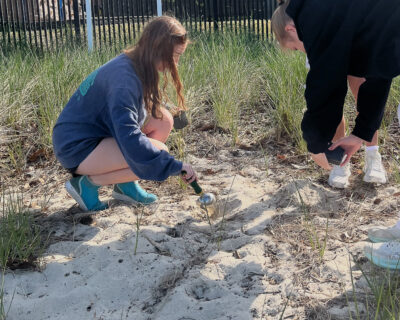
Students engage in a hands-on coastal marsh restoration project at Hilton Village this past Earth Day
Designed with support from the ASPB’s Plant BLOOME (Plant Biology Learning Objectives, Outreach Materials & Education) grant, “Growing Futures” is an inquiry-based curriculum that explores the science and restoration of coastal wetlands. The program helps students understand these habitats’ significance for climate resilience and ecosystem health by focusing on the vital role of salt marsh grasses in protecting coastlines, improving water quality, promoting biodiversity, and storing carbon from the atmosphere. Regardless of students’ geographic location, the tools provided by the new curriculum will allow for a deeper appreciation of the interconnectedness of ecosystems, foster ecological awareness, and inspire future leaders to play an active part in addressing real-world environmental challenges.
Like the unique learning opportunities in plant biology and agricultural science unlocked by the state-of-the-art Martha H. Patten Hydroponics Lab and STEAM Classroom, Gendreau’s and Ouellette’s curriculum reflects the HRA faculty’s commitment to innovation in teaching and learning, with a focus on practical applications, social and environmental responsibility, and community impact.
“Designing a curriculum that was accepted by a national organization demonstrates Dr. Gendreau and Mrs. Ouellette’s excellence in the field of biology,” Rous said. “But even more than that, they have connected to a national pool of like-minded educators who share resources and ideas with each other, and these resources will enrich the experience of their students.”
“Absolute Heroes for Our Coastlines”
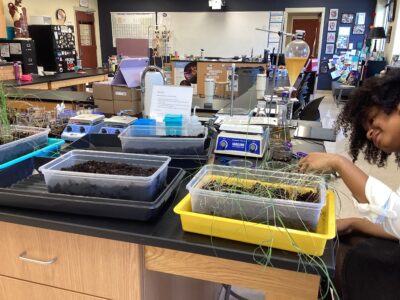
Navigators cultivate native grass plugs as part of the new salt marsh curriculum
Located between the York and James Rivers, HRA’s community is intimately linked to the marshes of the Chesapeake Bay watershed. Navigators drive past them with their families every day, but Gendreau and Ouellette found that few students knew what these important habitats were—let alone how much the local economy, regional fishing industry, and coastline defense depend on them. The two science teachers saw an opportunity to use the environment right in students’ back yard as a laboratory for applying classroom lessons and making a meaningful difference beyond HRA’s campus.
The project was personal for Ouellette, whose daughter completed a master’s thesis on coastal flooding and its effect on migratory waterfowl flyways. “Once we began looking at our area of Virginia and how the salt marsh grass wetlands are disappearing due to sea level rise and storm impacts,” Ouellette said, “the hope was to implement a schoolwide curriculum that would carry from the Lower School through the Upper School.”
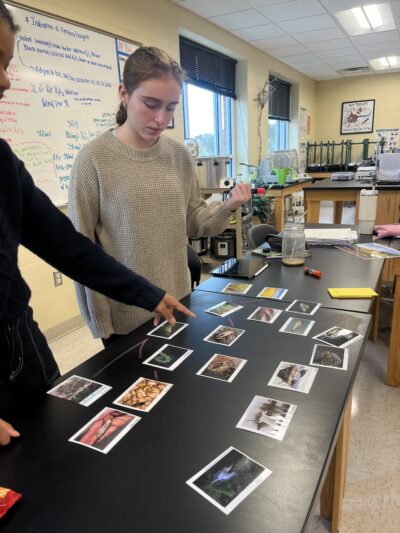
AP Biology students map out food webs to develop a deeper understanding of salt marsh ecosystems
Just over a year ago, starting with lessons and activities tailored to students in Grades 6-12, Ouellette and Gendreau successfully applied for a Plant BLOOME grant to develop the curriculum they envisioned. The program includes two tracks: “Salt Marsh Scientists” for AP Biology, AP Environmental Science, and general high school biology, paired with “Salt Marsh Explorers” for middle school life science. In the years to come, Ouellette and Gendreau hope to expand the scope of the curriculum, involving more Navigators, as well as other students nationwide, in an eye-opening and rewarding scientific learning opportunity.
“We want them to see why marshes are absolute superheroes for our coastlines,” Gendreau said. “They protect our shores from severe storm waves, filter pollution out of our water, and trap huge amounts of carbon underground.”
“Most importantly,” she added, “our goal is to inspire [students] to care about local nature, understand how their everyday choices affect the environment, and empower them to take active roles in community restoration as they grow into adults.”
“Students Get Their Hands Dirty”
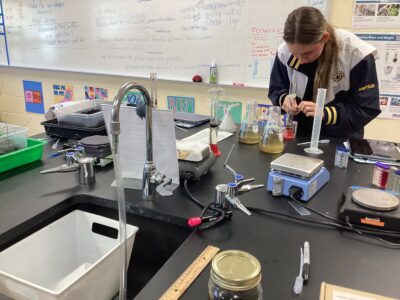
Analyzing real-world environmental data: students apply their knowledge of biology in the lab to determine practical solutions for ecological damage
The “Growing Futures” curriculum equips students to take action by bringing lessons off the page and outside the classroom. As Gendreau explained, “Instead of just reading out of a textbook, students get their hands dirty!”
Gendreau and Ouellette thoughtfully designed their activities to be affordable and accessible for teachers everywhere, making a fun and transformative ecological education possible for as many students as possible. Using materials like recycled food and beverage containers and garden soil, students start in the lab by building water filters out of two-liter soda bottles and studying the components of soil by shaking up samples in Mason jars. With materials now available online, students also sort plant cards to discover how grass survives in salty mud, map out food webs centered on such important species as the blue crab, and roleplay as environmental scientists, allocating a mock $130,000 budget for marsh restoration projects. Examining real environmental data from damaged marshes across the country, students apply their knowledge of biology to determine both the cause of the problem—be it wave erosion or fertilizer pollution—and the appropriate solution.
Students prepare to take their hands-on work into nature by raising grass plugs in their classroom and using plant cloning techniques to multiply them. Last spring, on Earth Day, Gendreau’s AP Biology class and Ouellette’s AP Environmental Science class transplanted plugs they had grown in the preceding weeks to a severely eroded beach just across town in Newport News’ Hilton Village. The applied learning experience came full circle for the students as they spent the remainder of the day exploring the grounds of the Mariners’ Museum and Park and observing local salt marshes in action.
Though the curriculum is designed to foster such first-hand engagement with the environment, Gendreau and Ouellette also included interactive virtual tours of marshes in their online modules to extend immersive opportunities to students in locations far from the coast.
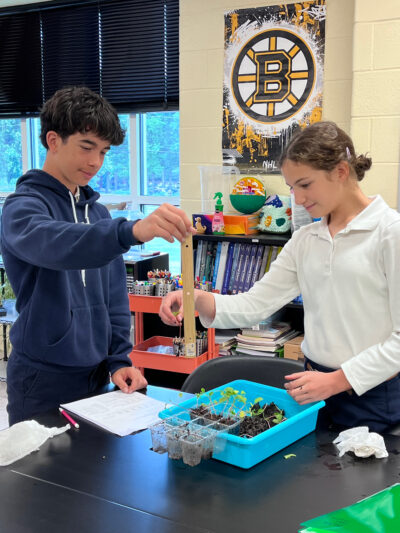
Middle School life science students study the effects of soil properties on plant growth
Fortunate to live just minutes away from multiple coastal wetlands, even more HRA students will complete the “Growing Futures” curriculum this academic year, connecting their classroom studies both to nature and to opportunities in the regional community. Beginning in the winter, Upper School environmental science and biology classes will once again raise native grasses under grow lights in the science hallway. During the spring semester, they will be joined by Ouellette’s Middle School life science students as they learn how they can make a difference by cultivating plants that serve crucial ecological roles. In late April, Navigators will bring their grass plugs to the Virginia Institute of Marine Science (VIMS) in Gloucester Point, where they will contribute to the restoration and protection of the local shoreline, step directly into a living marsh for a hands-on wildlife count, and meet environmental professionals to discover how they can apply their experiences at HRA to impactful coastal science careers.
With their innovative new curriculum, Ouellette and Gendreau are helping to chart a course for the future of science education, sparking young scholars’ passion for research and environmental stewardship both at HRA and in classrooms across the country. Their combination of expertise, curiosity, and vision is an inspiration to their students—and a quality that is the rule, not the exception, at Hampton Roads Academy.
“Put simply, students strive to learn more with a great teacher,” Rous said, “and HRA is lucky to have many great teachers.”