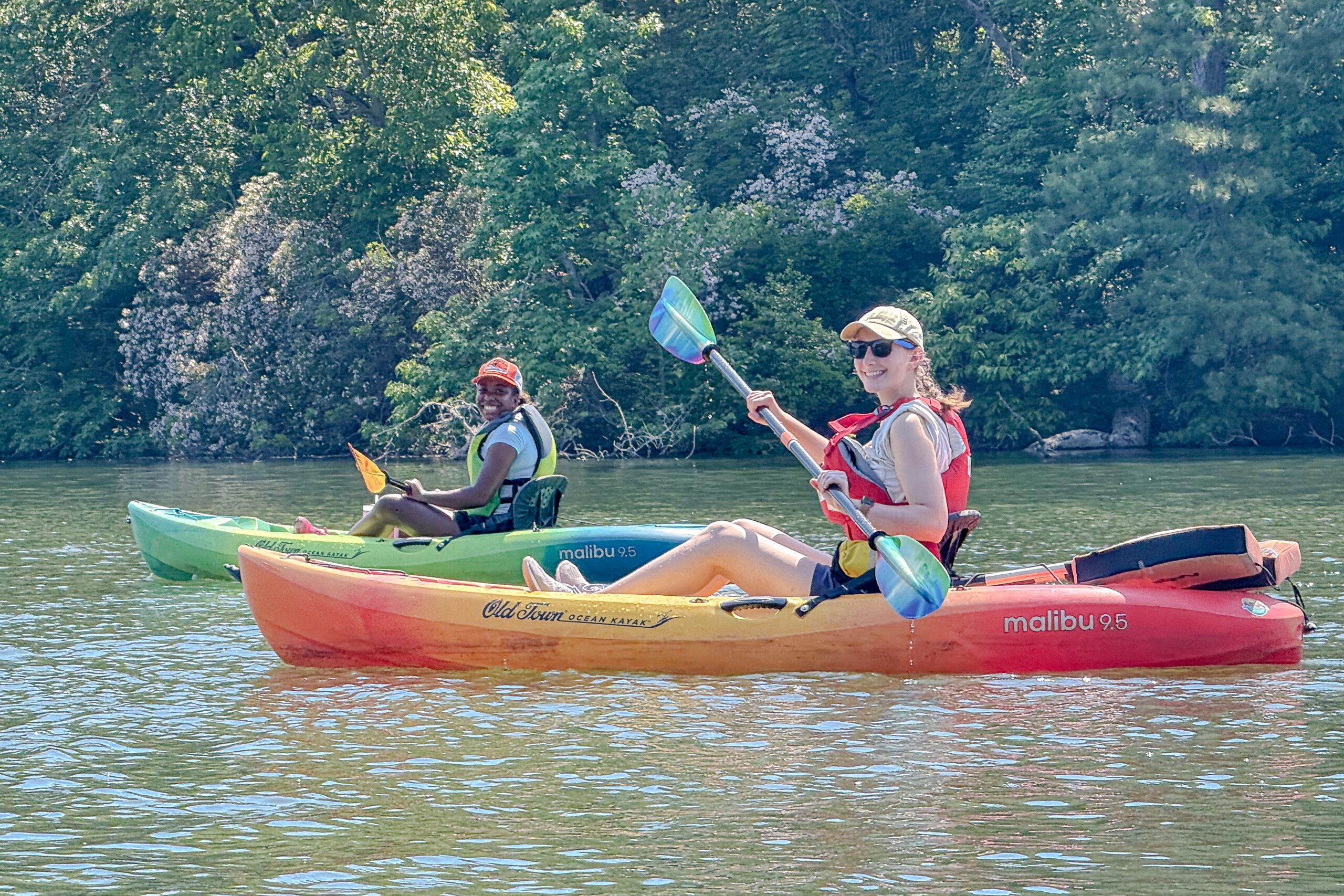
All smiles from HRA’s seventh graders as they kayak on Mariners’ Lake
For Middle School science teacher Marcy Ouellette, each spring is an opportunity to bring her students outside the classroom to “experience something they never have before.”
On Monday, May 18, Hampton Roads Academy’s seventh graders did just that when Ouellette led her life science classes on the fifth annual field trip to Mariners’ Lake, a beautiful 167-acre freshwater lake on the grounds of the Mariners’ Museum and Park in Newport News. The students spent the day kayaking, studying aquatic life, and constructing and racing waterborne vessels as a demonstration of principles of dynamics and buoyancy.
The experience was a stimulating blend of hands-on scientific learning and outdoor fun, allowing students to apply what they have learned this year about ecology and conservation while building a foundation for topics they will encounter in future STEM courses. Above all, the outing was a reminder that an HRA education begins on campus but is consistently engaged with the wider world.
Building New Skills and Confidence
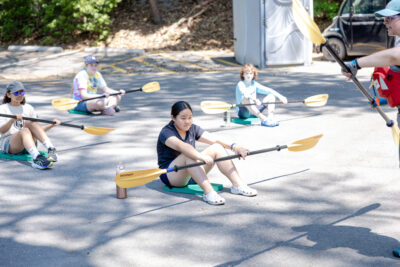
Students learn about paddling technique and safety before heading out on the lake
The seventh-grade Mariners’ Lake field trip was initially organized in 2022 through a partnership between then-Director of Middle School Lisa Thatcher (now Director of the Student Support Center) and former Upper School Spanish teacher Katherine Garner, whose husband Kelly still manages the Mariners’ Lake Program at the Mariners’ Museum. It has since become a beloved tradition, elevating both the curriculum and student life in HRA’s Middle School.
According to Ouellette, among the most valuable aspects of the trip is that both the experimental and physical activities are new to many of the students every year. A substantial portion of the current seventh-grade class, she noted, had never been in a kayak or spent much time on the water outside of a swimming pool before visiting Mariners’ Lake.
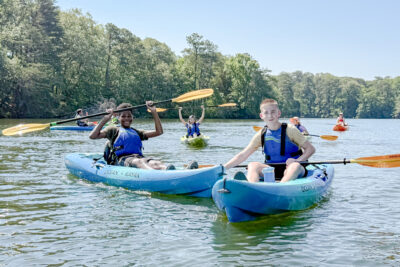
Seventh graders have a blast on the water
The day of firsts began with the students being split into groups of three or four and divided between two activities. Half of the students started by learning about safety in the kayaks with Mr. Garner, whom Ouellette described as “amazing with the kids” and skilled at “get[ting] the kids who you can tell are apprehensive or scared of doing it out on the lake.”
The most confident kayakers were given the freedom to explore the entire lake, while others safely paddled over a smaller portion of the body of water, with the least experienced not straying far from the shallow cove where they launched. With many laughs and smiles out on the lake as the students grew more sure of themselves on the water, kayaking was an undeniable highlight for the seventh graders.
Applied Learning and a Solid Foundation
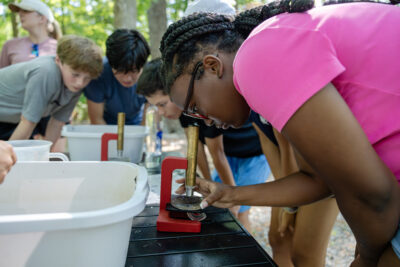
Scientific study in the field: students analyze macroinvertebrates under the microscope
As they awaited their turn in the kayaks, the second group of students completed hands-on scientific activities in two stations. In one, they used field microscopes to examine macroinvertebrates—worms, crayfish, nymph and larval insects—who had built their homes in leaf litter trapped in a net placed in the lake to collect organisms for roughly a month prior to the seventh graders’ visit. This exercise reinforced a range of topics Ouellette’s students had covered in the classroom, from plants and invertebrate animals to water quality and other facets of the natural world. Identifying and studying organisms “fresh out of the lake,” the life science teacher explained, deepened students’ understanding by allowing them to connect abstract concepts to a specific habitat in their community.
Crucially, completing this activity outside the laboratory gave students the opportunity to “get out and do some actual science off campus,” Ouellette said. One of her favorite parts of the field trip every year, she remarked, is witnessing the rapid shift from fear to fascination as her seventh graders encounter mayfly larvae and other “critters.”
Their enthusiasm for biology will lay a foundation for more in-depth coverage of the subject in Upper School, especially in science teacher Lauren Oaks’ oceanography course, open to students in Grades 9 through 12.
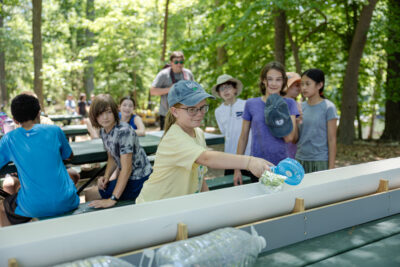
Hands-on learning: students put their miniature sailboats—and their knowledge of physics—to the test
More immediately, the seventh graders previewed topics they will cover next year in physical science at the second experimental station at Mariners’ Lake, where they were challenged to build and test miniature sailboats. Using supplies provided in kits, the students worked in groups to construct vessels and competed against their classmates to see whose boat would sail the fastest when propelled by a fan along a tube of PVC piping.
This friendly competition, according to Ouellette, not only offered a fun application of the physics of buoyancy and motion, but also helped foster camaraderie among the students.
After gathering for lunch, the kayaking and experimental groups switched activities, reconvening at the end of the day for a “circle group” to share what they had learned and most enjoyed over the course of the field trip.
Sparking Passions
Beyond merely reinforcing HRA’s curriculum, the visit to Mariners’ Lake also encouraged students to take their role in conservation seriously. Generating a grounded discussion about practical steps students can take, as members of their local community, to preserve the environment in and around the lake, the trip picked up on work that begins in the Lower School and continues in the Upper School years, in Ouellette’s words, “to get them to really start thinking about what we can do to fix things.”
“I learned about not leaving a trace,” said seventh grader Marin Mazzurco ’31, “and that if you leave trash in the lake, it will eventually pollute the Atlantic Ocean.”
Connecting scientific study with unforgettable activities one could not perform in a classroom setting, Ouellette explained, helps inspire the sort of passion that transforms students into responsible citizens. The fun of kayaking and conducting outdoor experiments is not merely an end-of-year treat, but also an experience that makes young learners invested in applying science for the benefit of the natural world.
This excitement is a gift that the students themselves pay forward every spring. “They always come back telling next year’s class how great it is,” Ouellette said.
After the trip, seventh grader Tommy Lanier ’31 marveled at how much he had learned about aquatic microbes as well as such topics as noise pollution and mindfulness. “I could not have ever learned these things without the experience of the outside, nature, and wildlife,” he said.
“It was also really fun to see the turtles sitting on the logs. We saw some baby ones, and they were so cute!” Mazzurco added. “It was so much fun to be out on the water, sitting in the middle of the lake, deep in nature.”

Making memories and embracing environmental stewardship