Elizabeth Cavallari, Director of College Counseling
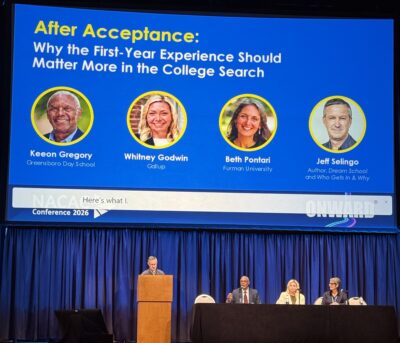
During the recent National Association for College Admission Counseling conference, bestselling author Jeff Selingo introduces a panel on the importance of considering first-year experience in the college search
During the first week of October, I spent a whirlwind week in Minnesota visiting colleges and universities and attending the annual National Association for College Admission Counseling (NACAC) conference. It was a week filled with exploring campuses, reconnecting with colleagues and friends, and learning from peers and experts in the field.
As I reflect on the week, I keep coming back to one particular session: “After Acceptance: Why First-Year Experience Should Matter More in the College Search,” a panel moderated by Jeff Selingo, a bestselling author, former editor of the Chronicle of Higher Education, and longtime advisor to university leaders.
The panelists challenged us to look beyond the “Big Five” of the college experience: football, fraternities, friends, food, and fun. Of course, these things matter! Campus culture, traditions, friendships, and overall college life are important parts of finding the right fit. But what about the day-to-day experience of actually being a student?
What does learning look like? Do students connect with their professors? Are they building relationships with faculty and administrators? Do they have mentors who encourage them?
These are the questions we should be asking.
Four in 10. Let that sink in.
I found one statistic from the discussion impossible to ignore. According to Gallup’s research on the state of higher education, only about four in 10 college graduates say they had a mentor who encouraged them to pursue their goals.
Four in 10. Forty percent.
We hear so much about the importance of building a network, making connections, and finding mentors. Yet fewer than half of students report having this kind of meaningful support during their college experience.
I immediately thought about my own time at Bucknell University, a liberal arts school in Pennsylvania. I can easily name four mentors who made a difference in my life. They were professors, faculty members, and administrators across campus who took the time to get to know me and help guide me through the decisions in front of me.
They helped me navigate changes in major, explore summer internship opportunities, and review my first job offer after graduation. When I started looking for a new job four years later, I knew whom I could call for advice. These were people who still knew me and wanted to see me succeed.
Their impact extended well beyond the classroom. They helped shape the choices I made and the person I was becoming. And I want that for every college student.
What This Means for HRA Students
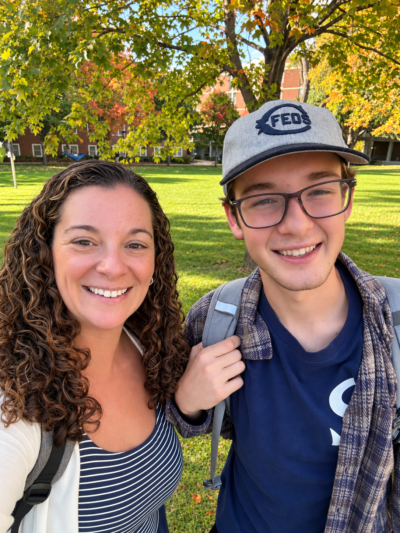
Cavallari reconnects with recent graduate Cam Hall ’26 at Macalester College in Saint Paul
At Hampton Roads Academy, relationships are at the heart of what we do. Our faculty know our students as individuals and invest in their growth. They are mentors and trusted adults who help students navigate challenges and identify and explore opportunities.
As Director of College Counseling, I see the value of these relationships every day. We take the time to understand each student’s goals and priorities, helping them find colleges where they will be known and supported. We ask the big questions: Will students connect with their professors? Will they find mentors who encourage them to pursue their goals? Will they have the support they need to thrive?
We want our students to leave HRA not only academically prepared for college, but also confident in their ability to build relationships and advocate for themselves. They already know what it feels like to be part of a community that believes in them. Our job is to help them find that same sense of connection in their next chapter.
That statistic of four in 10 has stuck with me since Minnesota. At HRA, we know the power of meaningful relationships, and we see the difference they make in our students’ lives. We fully expect our graduates to be among the four in 10 who can name a mentor who encouraged them to pursue their goals.