
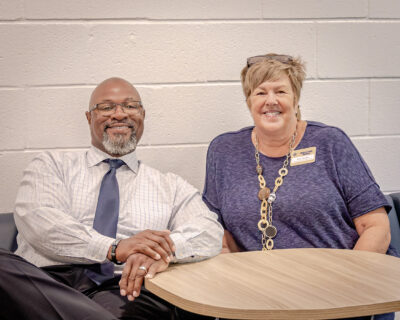
To kick off the 2026-2027 school year, Middle School student support specialist and varsity football head coach Rodney Taylor (left) joins Director of the Student Support Center Lisa Thatcher (right) as the SSC expands its services beyond the Upper School
The beginning of the 2026-2027 school year marks a new chapter for Hampton Roads Academy’s Student Support Center (SSC), an invaluable campus resource that empowers student excellence.
Having helped more than 70 Upper Schoolers boost their academic performance and develop personalized strategies for success since it opened its doors last August, the SSC will now expand its services to the Middle School with a slate of executive functioning skills courses for students in Grades 6 through 8, among other resources tailored to the developmental needs of Navigators at this stage of their education.
To provide targeted instruction and mentorship for HRA’s Middle Schoolers, Director of the Student Support Center Lisa Thatcher and Upper School Spanish teacher Noelle Rennolds will be joined by a new member of the SSC faculty, Middle School student support specialist Rodney Taylor, who also serves as head coach of the Navigator varsity football team. Taylor’s arrival coincides with the start of Abigail Whorley’s tenure as Director of Middle School and history teacher Kerry LiBrando’s appointment as Middle School Dean of Students, filling out a leadership team that shares the SSC’s focus on providing students in this division with the skills and confidence they need to excel in Upper School, in college, and beyond.
As Upper Schoolers return to the SSC this fall and Middle Schoolers visit it for the first time, they will step into a space that not only offers a wider range of services, but has also been physically transformed.
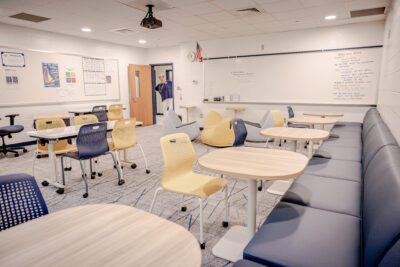
A bright, modern space designed around student needs: Thatcher excitedly surveys the transformed SSC
Thanks to generous support from former trustee and past Navigator parent Trip Ferguson ’67 and partnerships with current parents Lee Lockwood (a flooring professional as well as a former trustee) and Ruth Deibler (an interior designer), new carpeting and LED lighting were installed throughout the SSC over the summer. In late August, HRA added tables with whiteboard surfaces, comfortable chairs, and a banquette bench spanning the full length of a wall in room 2113. In the coming years, Thatcher envisions further renovations to optimize the student experience in the facility, including individual study booths and acoustic panels for the walls of the SSC. The director explained that she plans for students’ preferences and needs to guide her innovation within the space.
“The reimagining and ongoing expansion of the Student Support Center reflects the HRA community’s shared commitment to ensuring that all students—at every level—receive the personalized resources they need to achieve their goals and take ownership of their college-preparatory experience,” said Head of School Jay Lasley. “During our Year of Resilience, the SSC will play a critical role in helping our students grow into confident scholars who embrace setbacks as opportunities for improvement.”
Successes in Year One
The SSC is entering its second year with significant momentum on which Thatcher and her team are eager to build.
Though the program was without precedent at HRA, Upper School students and families enthusiastically welcomed the launch of the SSC, with approximately 40% of the entire student body in Grades 9 through 12 using its services and achieving an average GPA increase of 13% in the first year alone.
Pivotal to these impressive outcomes was the staff of six specially trained peer tutors who earned community service credit as they assisted their fellow Upper Schoolers in sessions ranging from 15 minutes to an hour before and after school or during study hall and flex periods. Thatcher delighted in observing older students review an assignment they had completed in one of their classes the year before and “translate it to teen-speak,” meeting tutees where they were.
Two tutors also provided homework help for Lower Schoolers, creating what Thatcher hopes will prove to be the foundation for a more robust interdivisional peer tutoring program. The preexisting Homework Club offered through HRA’s Extended Care Enrichment, the director suggested, could provide a framework for such collaboration as the SSC continues to grow.
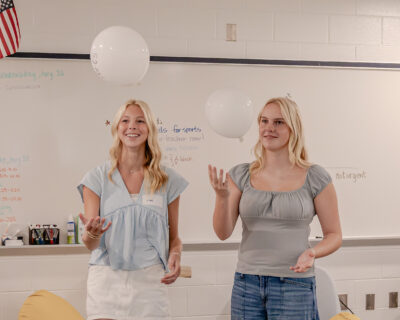
Learning strategies for managing work in school and beyond: students practice “juggling” responsibilities during an SSC orientation activity
During the spring 2026 semester, the SSC carried out a successful pilot program with the powerful, research-based educational platform MindPrint Learning. Beginning in January, students already utilizing the Center’s services completed the online MindPrint assessment, generating a personalized profile with insights into how each student learns best and resources to optimize academic performance based on one’s present strengths and areas for improvement.
Among the many promising results the SSC achieved, Thatcher pointed to “the atmosphere that the students have built in the guided study halls” as the most significant success story. Proctored by Thatcher and Rennolds, these study halls helped new Navigators and those attending for “grade recovery” develop valuable organizational skills as they prepared for upcoming assignments and exams. With guidance from educators who provide active mentorship, Thatcher observed, the students “are academically maturing, figuring out how they learn best, and really caring about their results.” Most importantly, they have capitalized on every resource available to them and dispelled any stigma around seeking support.
“That is, hands-down, the greatest thing that could’ve happened in this first year,” Thatcher said.
The SSC director is a firm believer in the motto “What is necessary for a few is good for all.” Other members of the HRA community heartily agree. Assistant Head of School and Director of Upper School Ben Rous has cited the SSC’s guided study halls as a potential model to emulate division-wide. Parents of students whose GPAs have risen above the threshold for “grade recovery” have expressed interest in having their children continue to utilize the SSC’s services, hoping to build on the exceptional benefits they have experienced in the past year. In addition to helping students improve their grades and study habits, the SSC has provided a roadmap for navigating collegiate-level student support resources once they advance to the next stage of their education.
Phase Two: Expanding to the Middle School
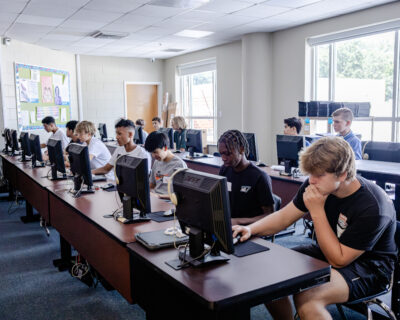
Incoming ninth graders complete the MindPrint assessment, generating personalized learner profiles to inform their Upper School studies
For the Upper School, the SSC’s second phase began during this August’s ninth-grade orientation. Launching what Thatcher described as “a much more intensive MindPrint experience,” each member of the incoming freshman class completed the platform’s online assessment and entered the Upper School with an individualized learner profile to inform their study habits for the next four years and beyond. These students will have the opportunity to reinforce crucial learning skills through MindPrint’s BOOST courses during Advisory periods throughout the year, and their teachers will be able to use their profiles to tailor their instruction to the various learning styles represented in the classroom. Within four years, every Upper Schooler will benefit from MindPrint’s unmatched insights and resources.
The greatest transformation for the SSC this year, however, will be its expansion into the Middle School. In response to overwhelmingly positive parent feedback on Middle School counselor Ashley Spruill’s fifth-grade course InFOCUS, helping new Middle Schoolers learn how to learn through an exploration of organization systems, conflict resolution, self-advocacy, and resilience, the SSC has introduced similar executive functioning skills classes for Grades 6 through 8.
This year’s offerings, taught by Coach Taylor, include the quarter-long courses School Skills for sixth graders and Level Up for seventh graders, along with the semester-long eighth-grade class My Notebook, pioneered by Thatcher during her time as the Middle School counselor (1996-2020). During his TEAM (Together Everyone Achieves More) periods, Taylor will also work in the SSC with students with learning accommodations.
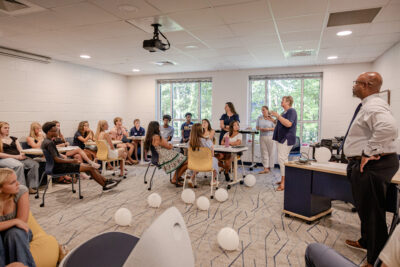
Navigators meet with members of the team who will support them through their college-preparatory experience (standing, left to right): Director of College Counseling Elizabeth Cavallari, Upper School counselor Elizabeth Rous, SSC director Thatcher, and Coach Taylor
Taylor, an educator with extensive experience as a middle school teacher and counselor as well as a mentor to student-athletes, helped Thatcher design a curriculum rich in experiential learning, employing games to simulate challenging learning situations and spur reflection on setbacks students might face in their school work within a low-risk environment. Across its Middle School classes, the SSC will introduce students to the reading comprehension improvement application ReadTheory, teach note-taking techniques, and discuss how to keep lockers clean and binders organized.
“The Student Support Center should be a place where students can make mistakes, ask questions, try different strategies, and learn without feeling judged,” Taylor said. “I want students to develop the confidence to approach a challenging assignment, a busy week, or an unexpected problem with a plan rather than feeling overwhelmed. I want them to understand that executive-function skills are learnable skills, not qualities that you either have or don’t have.”
As Taylor joins her team, Thatcher is excited to see him work closely with the Middle School faculty to help students understand how they learn best. “Being able to do that when you’re 10, 11, 12, 13, 14 years old is such a gift,” she said. “And then they’ll build on that as they get into Upper School.”
The Path Ahead
While guided study halls, peer tutoring, and the rollout of MindPrint Learning in the Upper School laid the foundation for the SSC to expand to the Middle School, Thatcher now hopes executive functions courses for sixth through eighth graders will provide a model for similar offerings for older Navigators.
Organization, time management, and the ability to take ownership of one’s own learning are among the most sought-after skills for college and career success. As part of a cohesive college-preparatory experience that begins the moment a student joins the Academy, HRA aims to strengthen these abilities early and reinforce them as students approach graduation.
The SSC will continue to play an important role in this vision as it grows further in years to come. The Center’s team plans to launch their third phase as soon as the 2027-2028 school year, with the addition of a dedicated Lower School reading specialist who will extend the facility’s services to all three of HRA’s divisions.
With Thatcher at the helm, the Student Support Center is poised to become one of the most impactful facets of the Navigator experience. “Her work there is immeasurable,” Lasley said. “I’m so excited to think about the future of this program under her leadership, because we’re just getting started with it. As we remain focused on cutting-edge academic programming for all of our students, we will continue to cultivate opportunities for them to develop academic confidence and resilience.”