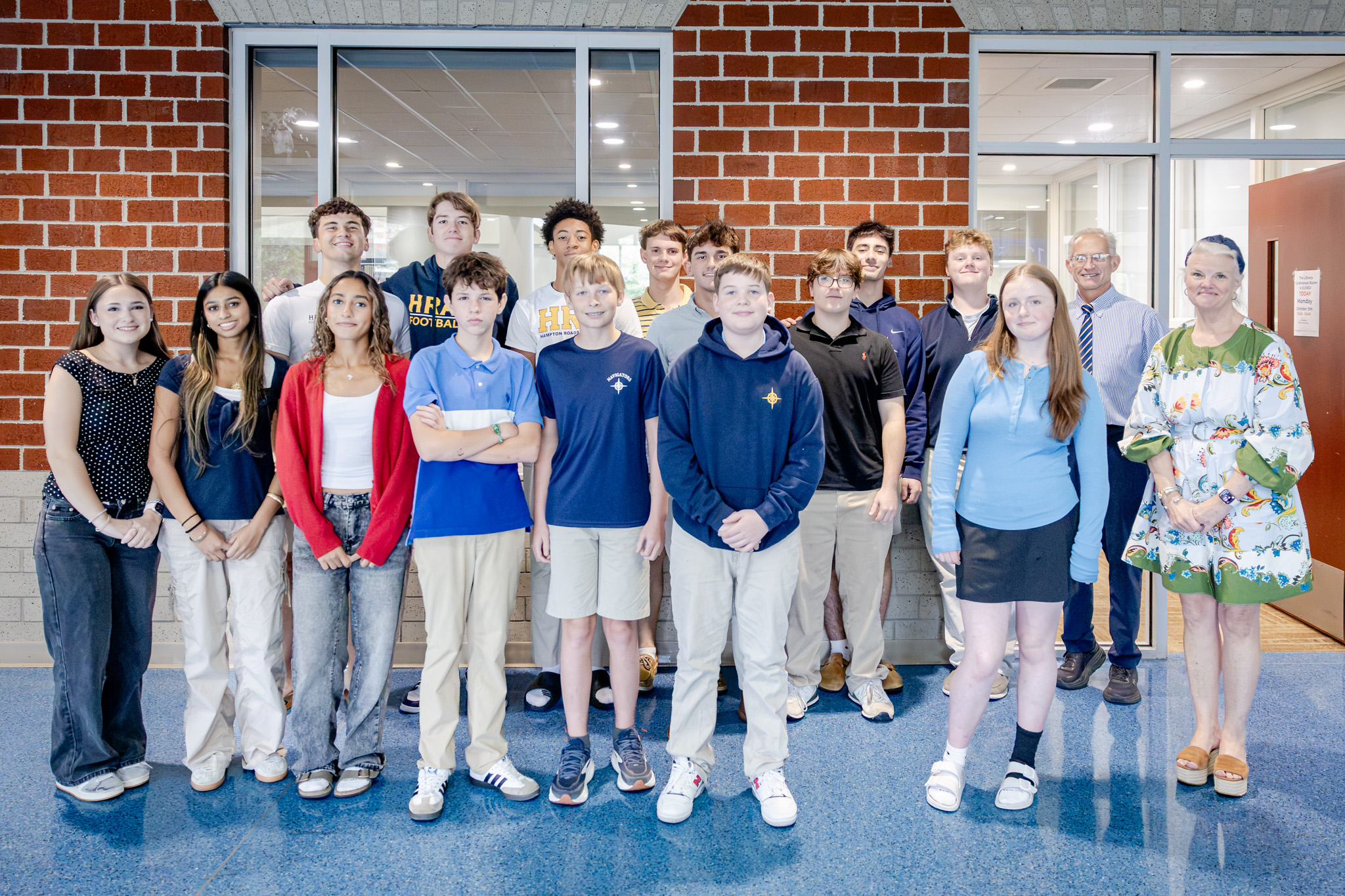
The socially conscious philanthropists of the future: the members of the 2026-2027 HRA Philanthropy Committee with faculty sponsor Tommy Yevak ’83, Director of Alumni Relations, and Director of Advancement Courtney Gardner ’85
According to Tommy Yevak ’83, Director of Alumni Relations at Hampton Roads Academy, “Being involved, being helpful, being a contributor to society is much more important than many of the things you can list on a college application.”
As faculty sponsor for HRA’s student-led Philanthropy Committee, Yevak takes pride in helping Navigators learn the value of “getting outside of yourself, understanding that communities are multifaceted,” and giving back through the experience of civic engagement.
Founded in 2021, the Committee is a training ground for the philanthropists of the future. Each year, members of this unique organization conduct extensive research on nonprofits serving the Greater Hampton Roads area and carefully review proposals for funding provided by the Mary P. Blalock Philanthropy Fund, named in honor of a departed member of the HRA staff who passed away in 2019. Last spring, the Committee received a record 45 applications, from which the students selected four highly deserving charities to receive $1,000 grants.
Having gained a deeper understanding of the nonprofit sector and the needs of their community, the 17 Upper Schoolers who serve on the Philanthropy Committee have set bold goals to grow their endowment, increase awareness of their mission, and magnify their impact across Hampton Roads in the coming year.
“There is a passionate network of philanthropic organizations throughout the Peninsula that are dedicated to addressing the needs of the local community,” said Committee Co-President William Stern ’28. “A larger fund would give us more opportunities to support people in need, make larger grants, and provide support to a greater number of organizations.”
By contributing to the Mary P. Blalock Philanthropy Fund, members of our community can help the Committee meet its objectives and advance civic education at HRA. This important work empowers students to grow into socially minded leaders and effect meaningful, positive change in the region they call home before they even graduate.
A Proud Legacy of Community Impact
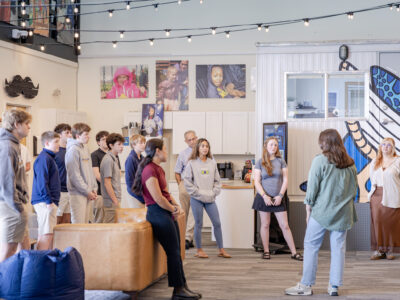
During their first site visit in fall 2026, members of the Committee learn about the mission of the Roc Solid Foundation, which provides resources for patients and families confronting pediatric cancer
Community service is integral to the Academy’s curriculum, which emphasizes excellence in character as well as academics. At HRA, students of all ages find opportunities to give back to their community, whether through applied learning projects in their classes or through such clubs as the Youth Volunteer Corps or Operation Smile. Most of these student organizations are singularly focused on a particular cause, allowing Navigators to contribute to a variety of volunteering and fundraising activities.
The Philanthropy Committee takes a broader approach. Its members not only engage in hands-on service at site visits to nonprofits throughout Hampton Roads, but also study the full array of needs within the regional community and the process whereby charitable organizations go about addressing them.
As Director of Advancement Courtney Gardner ’85 explained, this ambitious mission imbues the specially endowed Committee with a unique degree of responsibility. Every year, socially conscious Navigators self-select for the challenging task of researching issues in their community, getting the word out about their work through social media and press releases, evaluating dozens of applications from nonprofits, communicating with the organizations they choose to support, and serving as ambassadors for the school as they personally present grants to the recipients at the annual Founders’ Day and Memorial Awards Assembly in May.
“This isn’t the type of club where you’re just checking a box and putting it on a college application,” the advancement director said.
The students’ dedication to civic engagement carries on the legacy of Mary Blalock, a former nurse who later served in the HRA Advancement Office for 15 years, from 2004 to 2019, most recently as director of her department. According to Gardner, herself an experienced leader in the nonprofit sector who knew Blalock personally, “service was in her DNA.” After Blalock’s passing, with the blessing of her husband, Dr. Ward Blalock ’75, and her daughters Nora ’09 and Marnie ’12, the Academy created a permanently endowed fund in her memory to honor her extraordinary commitment to both HRA and the broader community.
By addressing local challenges with grants in Blalock’s name, members of the Philanthropy Committee proudly continue the work she started while gaining a deeper appreciation for the social responsibility that comes with one’s ability to meet a need.
“Lean into Your ‘Why’”
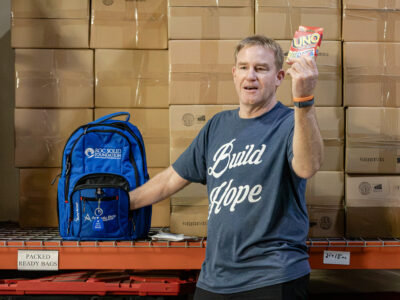
TJ Lynch, Director of Ready Bags at Roc Solid, explains how the organization prepares backpacks full of thoughtful gifts for families in the hospital with their children
Membership in the Committee is a learning experience that begins with research on the philanthropic process. “Nonprofits play a unique role in the community,” Gardner said. “They are the difference makers, bridging the divide between what families and individuals need—safe homes, nutritious meals, school supplies, medical and career support—and what the government is not always able to provide.”
Together, Gardner and Yevak teach Committee members what it means for a nonprofit to be an effective steward of its resources while tackling challenges in the areas of education, health and wellness, arts and culture, economic development, and the environment. As the group prepares to review grant applications, the Committee discusses how to assess both the text of a proposal and an organization’s tax return for evidence of measurable, timely, local impact.
“Some key points you should look for in a grant application,” said Anica Piatt ’28, the Committee member who oversees grants and grant writing, “are clearly mapping out how their specific activities directly lead to short-term outputs and long-term outcomes, a focus on outcomes—lives changed, income increased—rather than just outputs, and looking to see if the grant can properly fund their organization.” The students learn to consider such data points as the applicant’s record of fiduciary responsibility as measured by financial reserves and debts and the percentage of funding invested directly in services versus covering overhead.
As Co-President Trey Florakis ’27, a member of the Philanthropy Committee since his freshman year, noted, “You need to be able to visit the nonprofits to get a real sense of their mission and what they are trying to accomplish.”
Accordingly, the Committee takes a number of field trips to regional charities throughout the year to learn about potential grant applicants, form relationships with professionals in the nonprofit sector, and identify the community needs that resonate with them most. Past site visits have included opportunities for the students to volunteer in the food pantry at THRIVE Peninsula, learn about local housing challenges at the ForKids family shelter, and connect with young people in a part of the city many had never visited before at the Boys & Girls Club in downtown Newport News.
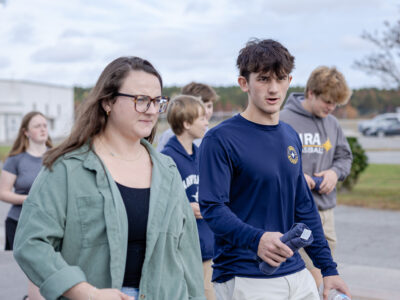
Forging connections in the nonprofit world: Philanthropy Committee member Tyler Motley ’28 learns about Roc Solid’s critical work during a conversation with Paige Konitzer, Director of Corporate and Foundation Relations
Per tradition, the students’ first trip of the current school year was a visit to the Roc Solid Foundation, an organization that provides assistance to families confronting childhood cancer, on Thursday, November 5. There, new members of the Committee learned the inspiring story of Roc Solid founder and chief play officer Eric Newman, the former owner of a successful construction company who lost his business during the 2008 financial crisis. Having survived pediatric cancer himself, he decided that his new purpose in life would be to channel his own experience into helping families dealing with similar challenges. With his immune system weakened due to radiation and chemotherapy, he could not play outdoors, so he understood that building playgrounds at these families’ homes and bringing backpacks full of thoughtful and useful gifts to patients in the hospital, as Roc Solid does today, could make all the difference for children in some of the most frightening chapters of their lives.
Newman’s message to the students, setting the tone for the Committee’s work, was simple: “Lean into your ‘why’”—a sense of purpose each person must discover for him- or herself.
“That’s such a powerful life lesson that really can inform social responsibility,” Gardner said, “whether that means starting a company or dedicating your life to nonprofits or just engaging in the political process of advocacy.”
Navigating an Expanding Mission
For seasoned members of the Philanthropy Committee, the process of researching and visiting regional nonprofits has been eye-opening.
“I was surprised by the wide range of charitable organizations in the region and the variety of causes they support,” Stern said. “I have also learned that philanthropy is much more nuanced than simply giving money to a charity. It involves identifying organizations that are making a meaningful impact, understanding the communities and issues they serve, and communicating about where we believe our support can make the greatest difference.”
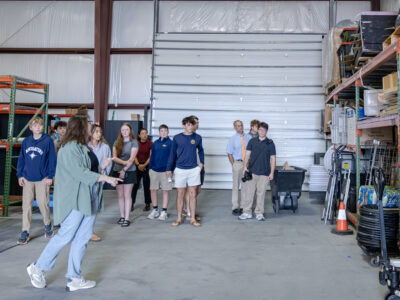
Understanding the scope of the community’s needs: Committee members explore a warehouse full of supplies at the Roc Solid Foundation
As the students have gained a broader awareness of their community’s needs, they have concluded that they will be able to make the most significant difference by investing a greater amount of money in a wider range of nonprofits each year. Committee leaders have set an initial goal of increasing the annual number of grants from four to five and offering each recipient more than the $1,000 they have awarded in past years.
In pursuit of this objective, the Philanthropy Committee will partner with the late Mary Blalock’s husband, Ward, a retired pediatrician and longtime supporter of HRA, to secure donations to grow the endowed fund that makes their grants possible. With a robust investment by current HRA families, faculty, staff, alumni, and friends of the Academy, the Committee will have the opportunity to back more worthy nonprofits and transform more lives throughout Hampton Roads. Crucially, each gift to the Mary P. Blalock Philanthropy Fund will enhance students’ learning experiences in civic engagement, helping shape the thoughtful, purpose-driven leaders of tomorrow.
“We want to help as many people as we can,” said Matt Jeffreys ’28, who manages donor relations for the Committee and, along with Stern, is spearheading the effort to bolster the Blalock Fund. “We’ve seen the results from last year, and it’s incredible to see the change we’ve been able to assist in, so we’re now trying to help more people.”
“Ultimately,” Stern added, “we want to expand the impact that the Committee can have on the local community.”
As she reflects on the Philanthropy Committee’s remarkable commitment to service, Gardner is certain of one thing: these outstanding students would have made Mary Blalock proud. “I know how important this work was to Mary,” she said. “She would be very gratified to see the evolution of this club in the past five years.”
Want to help the students of the Philanthropy Committee reach their goal and transform lives throughout the community? Click here to make a gift to HRA, designated for the Mary P. Blalock Philanthropy Fund, today.