Emily Goodson ’03 returns to HRA to provide Upper Schoolers and eighth graders with strategies for cultivating confidence, resilience, and self-advocacy
After delivering inspiring remarks for the Class of 2026 at their May graduation, Hampton Roads Academy alumna, author, public speaker, and disability rights advocate Emily Goodson ’03 returned to campus on Tuesday, September 22, for a moving and engaging presentation to students on building confidence and finding one’s voice, regardless of what others may say.
The morning assembly for the full Upper School and eighth-grade student body, held in the Svein J. Lassen Auditorium, included practical, actionable advice and resources drawn from Goodson’s personal experience as a person with a disability who worked for many years to achieve self-acceptance. Goodson detailed this journey in her acclaimed 2025 memoir Dating Disability: 15 Stories of Dealing with the BS and Building Confidence, from which she shared anecdotes during her visit.
Goodson’s message for the students was simple to understand but often challenging to internalize: “It is normal for all of us to feel self-conscious for a variety of reasons, and there are things you can do to have a better relationship with that voice in your head that is making you self-conscious.” She explained that subjects such as disability, mental health, and the value of speaking up for oneself and one’s peers were not widely discussed when she was growing up and struggling with her own “internal gremlins.”
“That’s why I like speaking in schools so much,” she said—“to help promote those conversations.”
According to Assistant Head of School and Director of Upper School Ben Rous, hearing an alumna, within the first month of school, tell her story of persevering through remarkable adversity and developing pride in her identity set the tone for HRA’s 2026-2027 Year of Resilience.
“This is resilience personified,” Rous said. “Not only has she overcome [her disability]—she is thriving,” touching countless lives with her empowering message through her writing, consulting work, and speaking engagements like her visit to her alma mater. “She transformed her journey into a roadmap for others.”
A Standout Student and an Accomplished Alumna
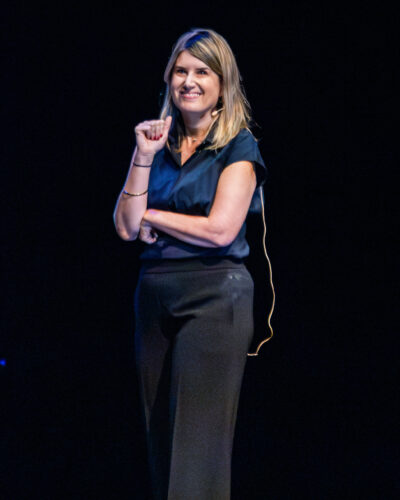
Having taken a long journey to self-acceptance, Goodson is in her element in front of audiences of students, sharing lessons she wishes she had learned as a teenager
When she was eight years old, Goodson suffered a brain injury that resulted in partial paralysis on the entire left side of her body. The next several years brought a difficult road to recovery, as she relearned how to speak, adapted to typing with one hand, and adjusted to walking with legs of different lengths. As Goodson recalled, however, physical therapy only helped her address one set of obstacles. Undoing the negative self-concept she formed after developing her disability—the true key to resilience in the face of disappointment—would take her decades.
Goodson never let the challenges she confronted stand in the way of academic, artistic, or professional success. Faculty members at HRA remember her as an exceptional student, an asset on the yearbook staff and forensics team, and a regular presence on stage in school plays and musicals. “You knew about Emily Goodson even if you didn’t have her in class,” said Rous, who started teaching at HRA during her time as a student. “She was a bright light on campus, … a go-getter,” and “a force for positivity at the school.”
After graduating from the Academy in 2003, Goodson went on to major in English and minor in education at Wake Forest University, then earned a master’s in student affairs practice in higher education from the University of Virginia. She taught and worked in education administration for a short time before pivoting into human resources, launching her current work to advocate for inclusivity in the workplace as well as schools. In 2020, Goodson founded the consulting firm CultureSmart, through which she engages in dialogue with partners from boardrooms to high schools on such topics as confidence, self-advocacy, identity, and the importance of embracing people’s differences.
Now a published author, she is able to reach wider audiences than ever before. But the opportunity to return to HRA, she explained, was especially meaningful, as she offered advice she wished she could have heard when she was a student at the Academy.
“The Intersection of Asking for Help and Resilience”
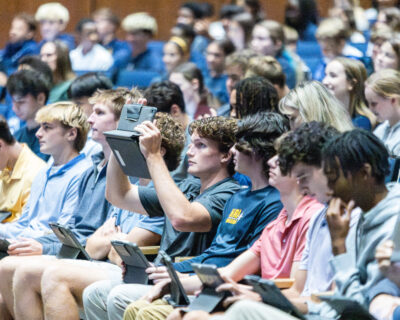
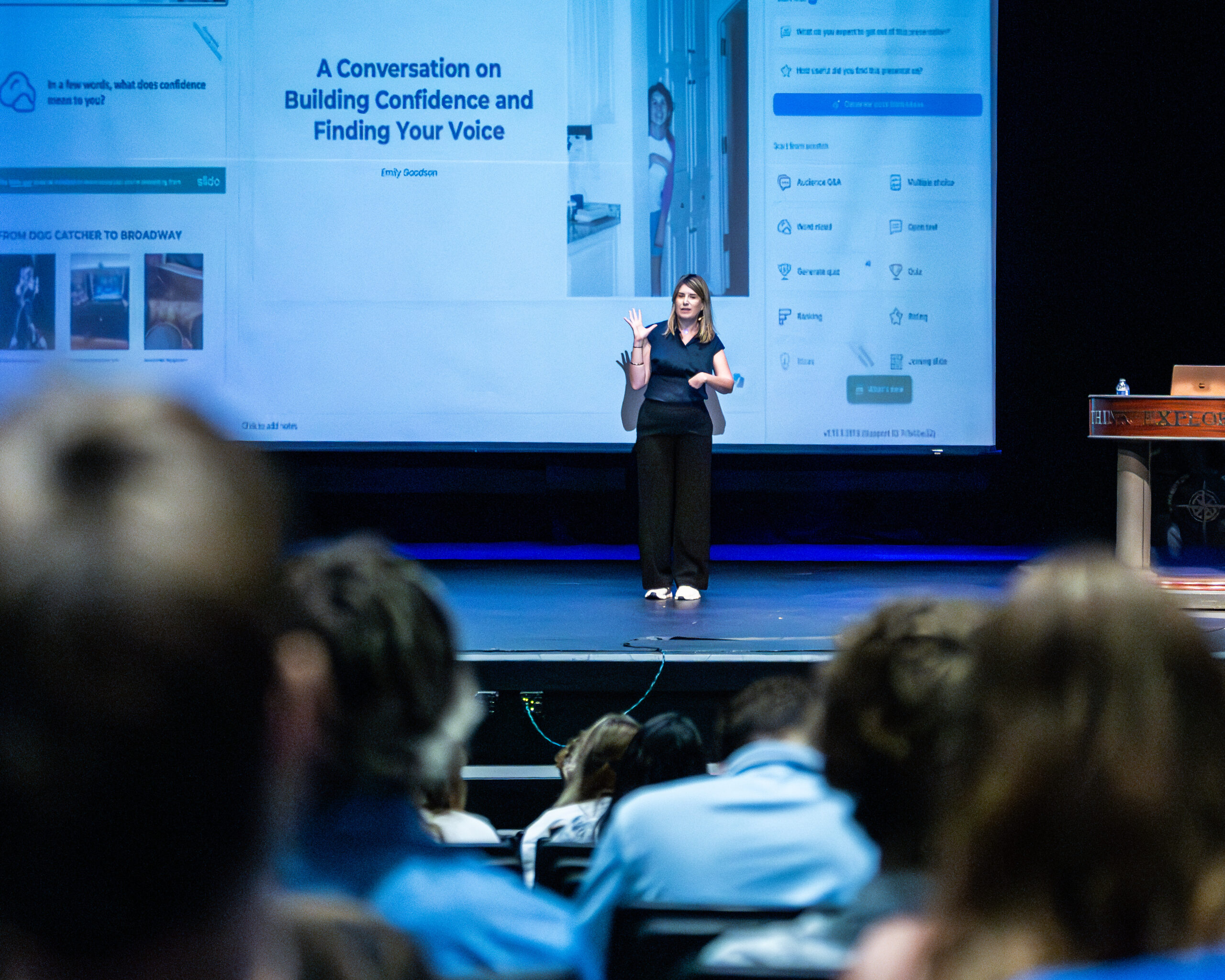
A highly interactive presentation: students respond to real-time digital survey questions exploring themes covered during the assembly
Goodson’s visit with HRA’s Upper Schoolers and eighth graders represented a continuation of a discussion she began with graduates and their families at Commencement 2026. Addressing a larger portion of the student body, she shared invaluable lessons from her journey toward greater confidence and emotional resilience. The highly interactive assembly included digital polling and word cloud activities, opportunities for students to reflect and jot down ideas on strategies for self-advocacy and self-care, and accessible live captioning for audience members who process information best visually. Goodson left ample time to engage directly with the younger Navigators, fielding questions about her personal and professional path, her most effective coping strategies, and (to her delight) her favorite Broadway shows.
The author drew on such episodes from Dating Disability as a Middle School social in HRA’s Multi-Purpose Room in the late 1990s, after which she concluded that a dance with her crush had not led to a relationship because she could not walk or move on the dancefloor like her peers. Later in her life, she told the students, she realized that her greatest hurdle was not her disability, but rather the sense of shame she had allowed to shape her vision of herself.
The climax of the presentation focused on the three “buckets” of resources Goodson has learned to tap in order to maintain a positive outlook and remain resilient in the face of challenges: knowledge of oneself and the knowledge of mentors, authors, and other experts; mindfulness tools, such as meditation, journaling, and exercise; and, perhaps most important of all, relationships.
Stressing “the intersection of asking for help and resilience,” Goodson challenged the students to consider how their relationships could make them more resilient by providing a network of support. “For a long time, I thought being resilient was doing it all by yourself” and “powering through,” she said. “That’s not true resilience.”
She also called students’ attention to the benefits of breathwork exercises, which she uses alongside meditation and auditory stimming to center herself when she feels overwhelmed.
Upper School counselor and AP psychology teacher Elizabeth Rous, who was instrumental in organizing Goodson’s visit, commented that this section of the assembly dovetailed perfectly with weekly work she has done with Upper Schoolers covering intentional breathing, cognitive reframing, and sleep hygiene. Goodson’s story of hard-won self-acceptance foreshadowed self-care topics she will cover in the year ahead, “with an emphasis on neuroplasticity and how negative patterns of thinking affect our emotions and behaviors,” Rous said. “Changing patterns is hard and often uncomfortable, which builds the resilience ‘muscle.’”
As Goodson observed during her presentation, the skills and strategies she outlined are ones that will pay dividends not only during students’ years at HRA, but throughout their lives. Her three “buckets” of resources are no different whether she is speaking at a school or in a corporate setting. HRA’s students, she insisted, will be better set up for success in their personal relationships and in their careers for having developed these strategies at a far earlier age than most adults—herself included.
Takeaways for the Year of Resilience—and Beyond
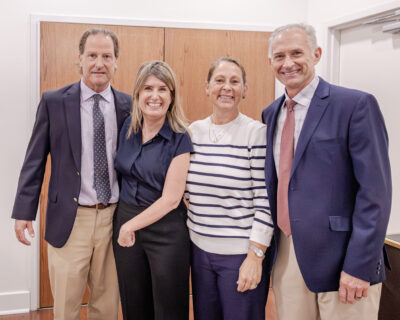
A fond reunion: Goodson with the team that brought her back to HRA (left to right)—Assistant Head of School and Director of Upper School Ben Rous, Upper School counselor and AP Psychology teacher Elizabeth Rous, and Director of Alumni Relations Tommy Yevak ’83
Following the assembly, Goodson sat down for lunch in the Lisa and Peter W. Mertz Meeting Room with school leaders, who expressed their deep gratitude for the words of wisdom she had imparted to the students.
Ben Rous shared his hope that students, regardless of how their individual experiences may differ from Goodson’s, see the resonance of her story in their own lives.
“School is adversity,” he said. “Even if we try to make it as comfortable and fun as possible, our students are challenging themselves, and there is the risk of failing.” From academic struggles and social stumbles to losses in sports and theatrical roles they do not land, setbacks await students throughout their educational journeys, especially at a rigorous school like HRA. By providing a supportive environment where students feel safe to take risks, experience disappointments, and try again, the Academy equips students with the resilience and confidence they need to navigate challenges in college, in their careers, and beyond.
If Goodson’s story proves one thing, it is that obstacles are unavoidable, but what we do when we encounter them is very much within our control. During the Year of Resilience, the entire HRA community will take this lesson to heart.