
Elizabeth Cavallari, Director of College Counseling
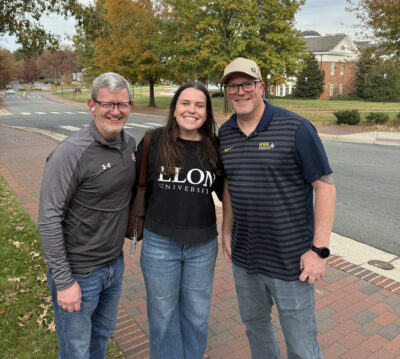
Associate Director of College Counseling Christopher Hailey and Upper School English teacher Jeremy Clover reconnect with alumna Cassie Dornan ’23—no stranger to the agony of waiting for admissions decisions—at Elon University
When I was in high school, which increasingly feels like the Dark Ages when it comes to college admissions, colleges offered binding Early Decision (ED) and Regular Decision (RD), while some offered rolling admissions. The ED and RD dates were consistent: November 15 and January 1, respectively. The process felt more straightforward. You knew what to expect, and the stress levels felt lower.
Now, it feels like the Wild West. Take, for example, four larger Virginia public universities and the timing of their admissions decisions:
- James Madison University: EA in mid-to-late January; RD in mid-to-late March
- William & Mary: ED1 in early December; ED2 in early February; RD by April 1
- University of Virginia: ED by December 1; EA by February 15; RD by April 1
- Virginia Tech: EA in late January to mid-February; RD in late March
How anxiety-inducing is this? There are no set dates, leaving applicants to wonder, stress, and build anxiety. I spoke with a highly selective school this fall, and while they couldn’t share the exact date ED decisions would be released, they told both counselors and applicants they would receive an email 24 hours beforehand. So what happens during those 24 hours? Does it help students to know a decision is coming, or does it distract them and heighten their worry? For most students, I think it’s the latter.
While I would strongly prefer colleges to work toward greater consistency for the benefit of students and applicants, that is outside my control. What is within the control of college counselors, like Associate Director of College Counseling Christopher Hailey and myself, is being present with students through the anxiety—maintaining an open-door policy for questions, nerves, and “what ifs” and helping students develop tools to manage the apprehension of what comes next.
Every year, we say that admissions decisions ultimately work out as they should, even with disappointment along the way, and that students will choose the school that’s right for them. Still, I wish I could take these wildly different deadlines away and give students one less thing to worry about. In the meantime, my office door is always open to provide support.