
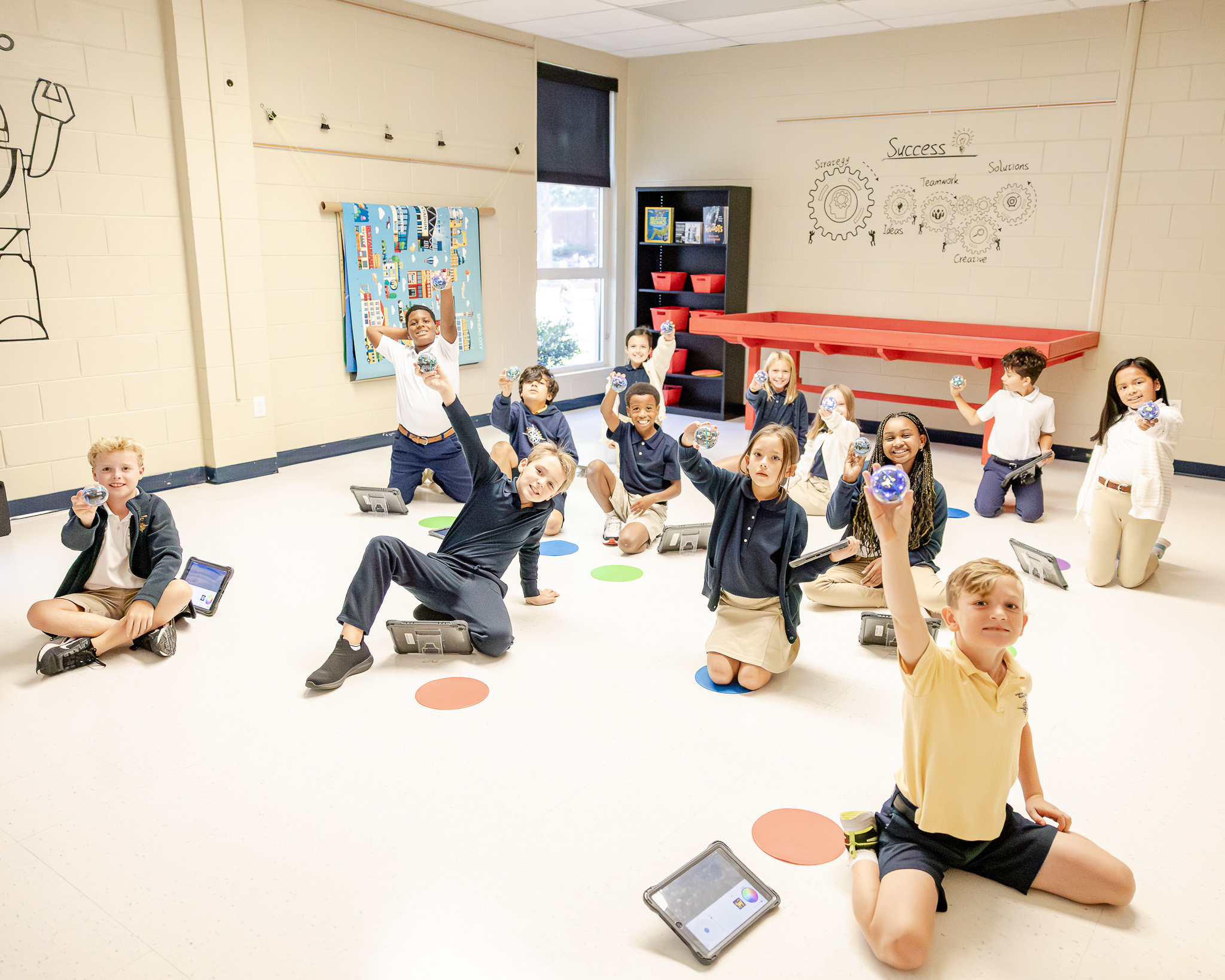
Students excitedly jump into hands-on learning in HRA’s new Lower School Robotics Room
When was the last time you saw a robot programmed by a third grader?
At Hampton Roads Academy, this question is not the setup for a joke. It is an invitation to witness our Lower School students learning and applying technical and critical thinking skills that will ignite their curiosity and fuel their future success.
Newly opened at the beginning of the 2025-2026 academic year, the Lower School Robotics Room for the first time provides a dedicated space at HRA for students in Pre-Kindergarten through Grade 4 to explore coding and make use of robots to enhance lessons across the curriculum.
This exciting facility, according to Director of Lower School Susanne Swain ’78, offers “endless opportunities for STEM engagement. The robotics program will increase students’ problem-solving abilities, develop their collaboration skills, enhance their computational thinking, and expand their creativity.”
Cutting-Edge Resources Accessible to All
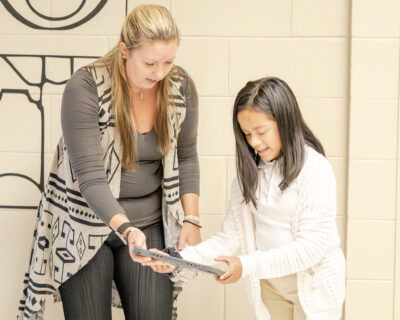
Lower School science enrichment and computer teacher Tiffany Brakefield assists a student with coding tasks on her iPad
Robotics has been part of the Lower School curriculum at HRA for several years. Prior to the creation of the new Robotics Room, however, space to store and use the necessary equipment was sorely lacking in the Lower School computer lab.
As Lower School science enrichment and computer teacher Tiffany Brakefield explained, the Robotics Room at last affords sufficient space for robots to move freely and for students, consequently, to engage in more “project-based learning.” Spearheading the development of the new classroom, Brakefield has already formulated numerous lesson plans geared toward hands-on applications of robotics.
Third and fourth graders will use the facility for regularly scheduled robotics classes throughout the school year, but starting in October, Brakefield will support Lower School teachers at all grade levels who wish to use the classroom for lessons tailored to the particular learning needs of their students.
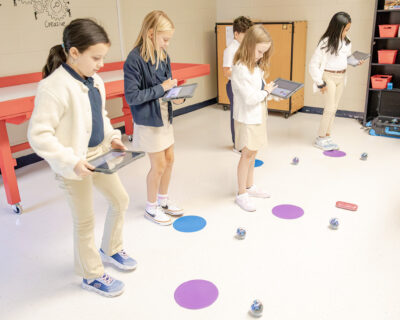
Fourth graders program Sphero robots to navigate the space of the Robotics Room
The core equipment the space offers consists of ball-shaped Sphero robots to be used by older students. These devices are synced with an app programmed on the students’ iPads that offers activities not only in robotics, but in a range of subjects, including language arts and mathematics. For younger learners, the Robotics Room offers Sphero’s indi sets, which include small vehicles controlled by colored mats read by the devices’ sensors. The “indis” provide an age-appropriate learning experience for students in Pre-K through Kindergarten, who are less experienced with the use of iPads and have not yet learned the block coding that more advanced Lower Schoolers use to program their robots through graphically formatted commands. Students gain an introduction to block coding in Kindergarten, though instruction in the technique does not begin in earnest until first grade, when students begin to complete activities on the computer science learning platform Code.org.
The Robotics Room will be an asset in preparing Lower School students for the next stage of their Navigator journey. A high priority for Middle School Director of Educational Technology Melissa DeBoer and her colleagues is ensuring that students entering their technology program from the Lower School have a command of block coding so that they are prepared for more advanced coding challenges.
As the Lower School coding program has expanded, students as young as fourth grade have developed the ability to use block coding to make videos and songs. By completing a wider variety of coding projects and observing tangible results in the Robotics Room, students will build an even stronger foundation for using languages like Python to tackle more complicated tasks, such as controlling character movements in video games.
The Future of Robotics at HRA
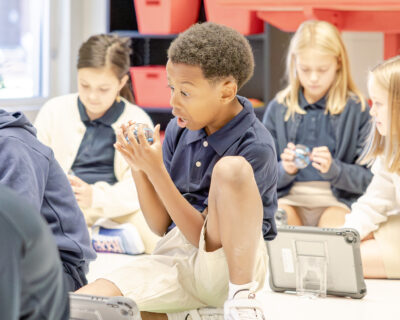
Robotics projects nurture and inspire young minds in the Lower School
Early exposure to robotics, coding, and their applications, Brakefield noted, can play a powerful role in sparking students’ interest in such topics and demonstrating “that you can have fun learning … across the curriculum.” It also “makes them feel more confident and comfortable” as they encounter a more demanding technology curriculum in later grades.
Creating positive learning experiences at every stage will help students feel more open to STEM career options as they prepare to chart their professional trajectories in college. For those who choose paths outside of the sciences, activities in the Robotics Room will prove no less valuable, as Navigators draw on the creativity and adaptability they developed there to solve real-world problems and overcome obstacles throughout their lives.
As Brakefield looks ahead to the future of the Robotics Room, she is actively researching new types of robots—especially more anthropomorphic models—to incorporate into the classroom. She also aims to branch out into the engineering aspects of robotics, inviting students to move from coding basics toward building robots of their own. This would open the door to exciting co-curricular opportunities, such as a robotics club that would equip a team of Lower School students to enter interscholastic competitions.
With the field of robotics constantly evolving, there is no limit to the enrichment opportunities that HRA’s Robotics Room could supply.
“It is our hope that this fun, engaging learning environment encourages growth and inspires minds,” Swain said.