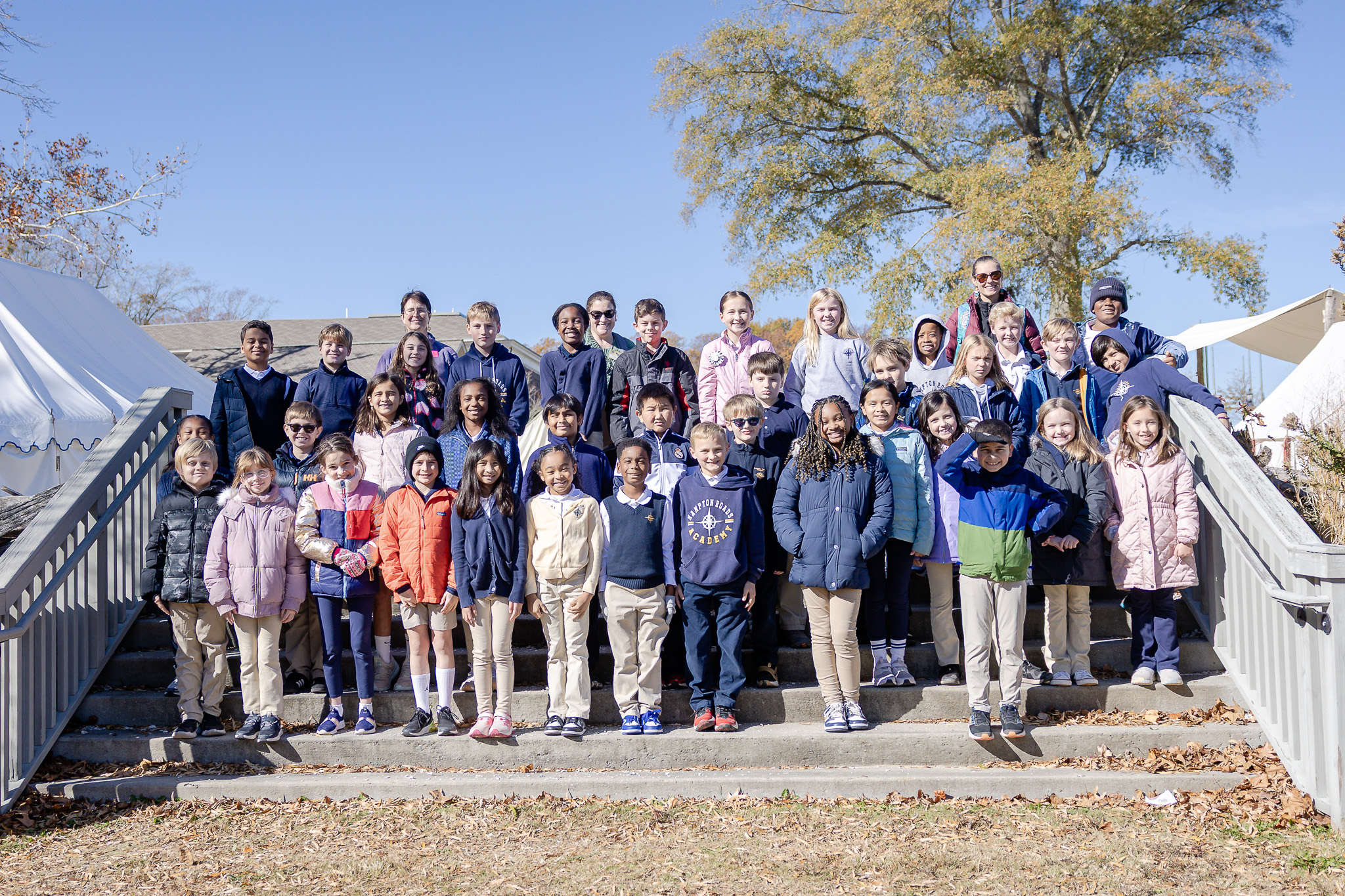
Fourth-grade teachers Jennifer Massengill, Gretchen Speece, and Savannah Whitten bring their students to the American Revolution Museum at Yorktown
With the United States semiquincentennial just a few months away in July 2026, Hampton Roads Academy’s fourth-grade classes took their studies out of the classroom and straight to the location of one of the most important events in the nation’s founding.
On Wednesday, November 11, the students visited the American Revolution Museum at Yorktown, just a stone’s throw away from the site of the decisive British surrender to the Continental Army in 1783.
The excursion, a first for HRA’s Lower School team, was a natural complement to the fourth-grade history curriculum. “This field trip allowed the students the opportunity to take a step back in time and experience their Virginia studies lessons with immersive, hands-on learning,” said fourth-grade teacher Gretchen Speece. “We are fortunate that Yorktown is a short distance from our campus.”
As Speece noted, the timing for a visit to a war museum—particularly one dealing with the Revolution—could not have been more ideal. The trip followed immediately on the heels of Veterans Day on November 11 and the 250th anniversary of the establishment of the Marine Corps by the Continental Congress on November 10, 1775.
While military history is central to the story the museum tells, the insights the fourth graders gained from their visit extended far beyond battles and treaties. According to fourth-grade teacher Jennifer Massengill, the museum’s multimodal approach, encompassing interactive media and live demonstrations as well as traditional galleries, “help[ed] the students see the people of the Revolution as real people, who faced challenges, made sacrifices, and made a life for themselves—not just stories in a book.” When students have the opportunity “to see, touch, smell the things we have been learning about in our classes,” she explained, history becomes personal and truly comes alive.
An Immersive Experience
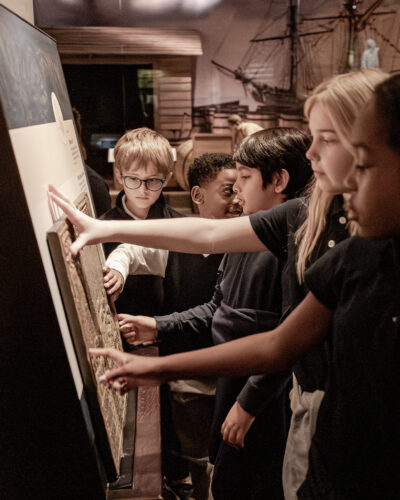
Students explore the immersive museum galleries
The students’ guided tour offered no shortage of unique ways to learn about life during the Revolution and the development of the early United States.
Following a trip to Jamestown earlier in the school year, highlighting the establishment of the first permanent English settlement in North America, the visit to Yorktown allowed the fourth graders to appreciate how colonial society and politics in Virginia and beyond had evolved in the century and a half leading up to the revolutionary era. In their classes prior to the trip, the students had learned about brewing discord between the colonies and the British government on the eve of the war. As fourth-grade teacher Savannah Whitten noted, “our trip to the museum [showed] them just how important those disagreements were for the formation of our country 250 years ago.”
The galleries of the American Revolution Museum allowed the students to discover this story through historical artifacts, dynamic dioramas, an introductory film in a theatre with 180-degree surround sound and special effects, and various interactive features. These engaging exhibits cover not only the political roots of the revolutionary struggle, but also colonial culture and lifeways, significant battles such as Great Bridge and Yorktown in Virginia, conditions on the home front, efforts to construct a new nation and Constitution after the fighting had stopped, and the intersecting lives of Euro-American settlers, free and enslaved African Americans, and Native American groups forced to choose sides.
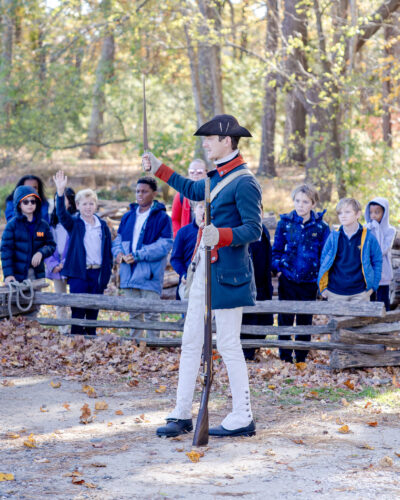
An historical interpreter demonstrates how to affix a bayonet and fire an eighteenth-century flintlock musket
The museum’s outdoor displays provided an even more immersive learning experience, enabling students to use all five senses in recreated eighteenth-century settings.
A Continental Army encampment, complete with rows of tents for soldiers, a period-accurate earthen kitchen, and reconstructed quarters for officers, a quartermaster, and a surgeon, deepened the students’ understanding of the logistics and harsh realities of warfare during the Revolution. Guided by costumed interpreters, the fourth graders studied surgical equipment to learn about medical practices in the eighteenth century and observed makeshift dwellings illustrating the living conditions of female relatives of soldiers who earned wages performing crucial domestic labor to support the needs of the army. Adding excitement to the experience, the interpreters reenacted the daily routines of Continental soldiers, including the loading and firing of a flintlock musket.
The students also visited a recreated revolutionary-era farm, depicting the well-documented daily life and chores of eighteenth-century York County farmer Edward Moss, his wife Martha Garrow, their four children, and the six African Americans they held in bondage. Exploring a reconstructed farmhouse, kitchen, tobacco barn, gardens, and crop fields, the fourth graders learned about the challenging material world and profoundly imperfect social structures of the founding generation.
Bringing Revolutionary History Back to HRA
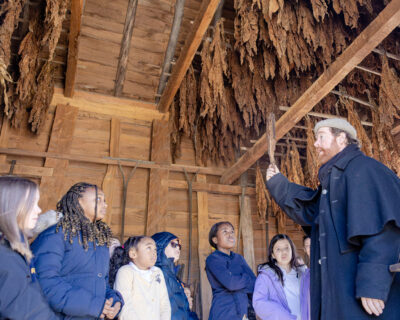
Students learn about the fabric of daily life during the founding generation at a reconstructed revolutionary-era tobacco farm
According to fifth-grade social studies teacher Michelle Miesko, experiences like the fourth-grade field trip to the American Revolution Museum lay an excellent foundation for the curriculum students will tackle once they enter HRA’s Middle School, picking up with U.S. history and government after independence.
The most important lessons for students to learn before making this transition, Miesko noted, transcend surface-level facts about the past. “History is learning about the people and their lives, not simply a series of names, dates, and places,” she said. “It’s important to see leaders and figures from the past as humans with flaws who made difficult decisions and also mistakes.”
Moreover, she explained, studying the Revolution hands-on illuminates the “relationships and connections” at the heart of history. “These relationships can mean the difference between brokering peace or engaging in conflict, forming an alliance or becoming an adversary, and gaining freedom or restricting rights,” Miesko said. “In order to deepen students’ understanding, knowing the backstory of the events and actions that preceded them can provide valuable insight and facilitate connections for the students to the people and events that we study. I love that students are making these connections in fourth grade with the wonderful opportunities and resources the fourth-grade teaching team provides.”
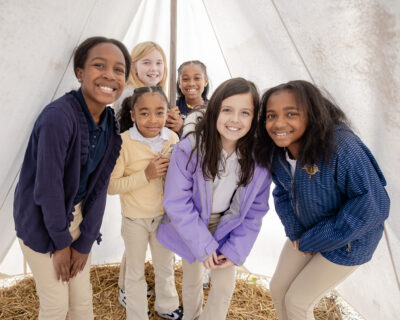
Students gain insight into the life of rank-and-file soldiers at the museum’s recreated Continental Army encampment
Indeed, by grounding America’s story in a local setting, the fourth graders’ visit to Yorktown opened their eyes to the rich history that surrounds them on the Peninsula—and what a privilege it is to be immersed in such a legacy.
Hands-on lessons about the country’s debt to soldiers, officers, and other courageous patriots in centuries past also deepened students’ appreciation of the ways in which this legacy lives on in their own families and in the Navigator community. In this sense, the fourth graders’ field trip was a perfect prelude to the Lower School’s “Salute to the Military” at their Friday, November 14, Leadership Assembly, paying tribute to both veterans and active duty service members with renditions of patriotic songs by students in all grades, culminating with a performance of “Thank You, Soldiers.” The Upper Schoolers, led by Student Council Association President Colten Fulcher ’26, similarly recognized veterans and their spouses during their homeroom on November 11.
“We are rich in military families,” said Director of Lower School Susanne Swain ’78. “It is so meaningful to show these families how much we value them as part of our community at HRA.”