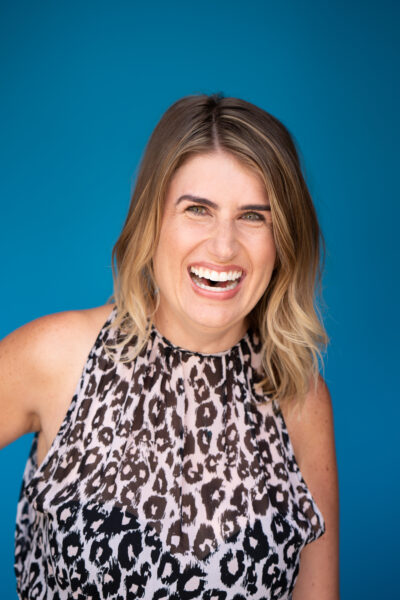
Emily Goodson ’03, HRA’s 2026 commencement speaker (photo credit: Michael Desmond)
Hampton Roads Academy is thrilled to welcome alumna Emily Goodson ’03 back to her alma mater this spring to deliver the 2026 Commencement Address. Drawing on her personal experience as a person who has lived with a disability since childhood and devoted her career to advocating for accessibility, she will inspire the graduating seniors and their families, friends, and teachers with thought-provoking remarks in the Svein J. Lassen auditorium on Saturday, May 30.
Goodson has worn many hats over the course of her career. With backgrounds in both teaching and education administration, she is currently an author, public speaker, and thought leadership partner to a wide array of organizations, consulting on the topics of inclusion, accessibility, and workplace culture. In December 2025, she published her first book, Dating Disability: 15 Stories of Dealing with the BS and Building Confidence, presenting a series of episodes from her life that underscore the beauty that lies in our differences, no matter what others may say.
Dedicated to protecting the rights of underrepresented groups, Goodson embodies HRA’s commitment to cultivating ethical and compassionate leaders as well as outstanding scholars, athletes, and artists. As the Class of 2026 prepares to embark on new journeys beyond our campus, there could hardly be a more exemplary model of how to chart a path of purpose and impact.
For Goodson, speaking at HRA’s Commencement Ceremony will be a heartwarming homecoming to the school where she discovered a sense of community and developed skills that have informed her life’s work at every stage.
Early Challenges and Strong Foundations
At the age of eight, Goodson suffered a brain injury that left the entire left side of her body paralyzed. In the years that followed, she surmounted incredible obstacles on the road to recovery. She worked to relearn how to speak, adapt to typing with one hand, and adjust to walking with legs of different lengths.
These early challenges would ultimately inspire her to give voice to people like her, whose resilience she rarely saw depicted on stage, on screen, or in public life. She did not, however, allow her disability to define her future. Her unique experience would be her story to share, but it would not limit her possibilities.
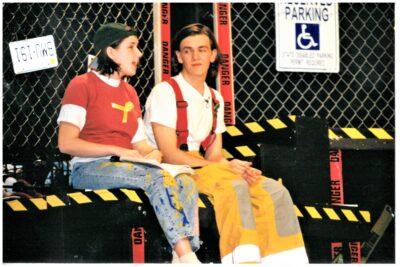
Goodson appears alongside her classmate Cary Mitchell ’03 in their senior-year musical at HRA, Godspell
Joining HRA in sixth grade, Goodson excelled as a student. She distinguished herself by acting in plays and musicals every year through twelfth grade and by leaning into storytelling as a member of HRA’s forensics team during her Upper School years. Goodson credits these opportunities outside the classroom at HRA with planting the seeds that have grown into a successful career. “It’s interesting to see that my book and the work I do with companies is all story-based,” she said.
According to Interim Director of Middle School Karen Gillespie, her longtime Spanish teacher and one of her most beloved instructors, Goodson was always “a fun-loving, optimistic, hard-working, talented student and a joy to have in class.”
“Her physical challenges were never an impediment to her spirit and, frankly, are not at all what I remember about her,” Gillespie added. “I am constantly impressed, but not surprised, by her accomplishments.”
Gillespie and other favorite faculty members like former English teacher Heather O’Toole, Goodson explained, “helped me start to identify who I wanted to become and what I wanted to be.” She recalled, for example, two school trips on which O’Toole took her and her classmates to New York to see theatrical performances. Goodson knew from that moment that she wanted to live in New York one day—and indeed, she now does, advancing accessibility and inclusion by sharing her personal stories.
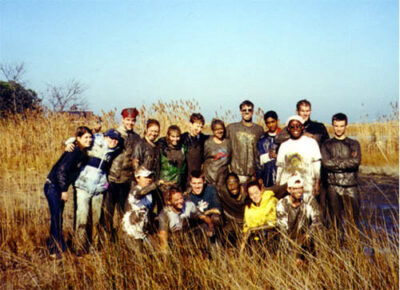
A “broadening of the aperture”: Goodson’s AP Biology class poses during a field trip to the Chesapeake Bay
“It was really that broadening of the aperture that my education gave me,” she said. “It helped me to see things that I wouldn’t have known were possible.”
Equally important was the community Goodson built at HRA, including many classmates and peers from other years who remain good friends. This strong network, she noted, helped her learn the importance of maintaining relationships and both helping and accepting help from others, skills that have proven to be assets throughout her career.
Above all, her experiences at HRA—especially O’Toole’s mentorship—taught her to love literature, think critically, and remain curious. These abilities, according to Goodson, have been crucial to her success not only as a writer, but also as the founder of her own business. “In order to be an entrepreneur, you have to be curious about yourself, curious about the market, curious about what is needed, and not be afraid to think outside the box,” she said.
Amplifying Underrepresented Voices
After graduating from HRA in 2003, Goodson went on to earn a bachelor’s in English, with a minor in education, from Wake Forest University and a master’s in student affairs practice in higher education from the University of Virginia. Her degrees informed her initial career trajectory, as she taught high school English for a year and then worked in administration in the graduate business school at Wake Forest for a year and a half.
Soon, however, she realized that she wanted to pivot into human resources and advocate for workplaces that are inclusive of all people, regardless of their differences.
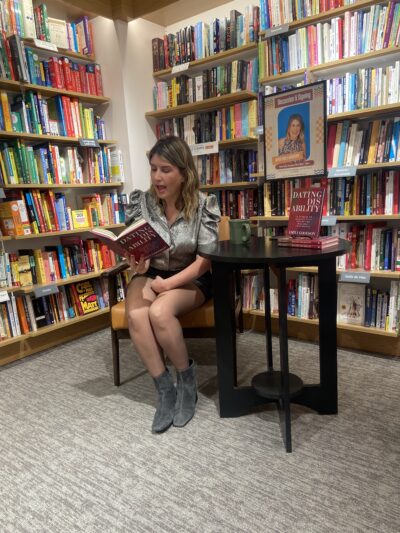
Goodson reads a portion of her debut book, Dating Disability, during a recent public appearance
In 2020, Goodson established CultureSmart, an HR consulting firm for startups. The company’s mission has since broadened, giving Goodson the opportunity to serve as a consultant for employee networks at a variety of companies and speak on accessibility for audiences of high school students and young adults. She engages all her partner organizations in meaningful dialogues about confidence, self-advocacy, and identity relating to groups such as women and veterans as well as people with disabilities.
With the publication of Dating Disability late last year, Goodson has extended these conversations to an even larger audience. The book, an expansion of an article she wrote four years ago for the Los Angeles Times, represents an attempt to address the lack of literature examining the intersection between disability and intimacy. Drawing on the author’s personal experiences with romance, relationships, and the pursuit of self-acceptance, Dating Disability offers readers a concrete “roadmap” as they work to build their confidence and sense of self-worth.
Goodson’s hope is that, after reading her book, people with disabilities and others facing similar challenges feel hopeful and empowered to redefine themselves beyond the narratives prescribed by society.
“At a very basic level,” she said, “I knew that this book would have helped the 16-year-old me.”
Inspiring the Next Generation of Navigators
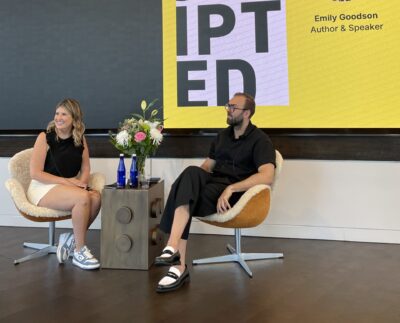
The importance of representation: addressing eager audiences, Goodson shares her book’s invaluable message of self-acceptance and models success as a person with a disability
Goodson enthusiastically accepted the invitation to speak at this year’s graduation exercises in large part because she has begun to see the impact her writing has had on younger readers. As she explained, she finds it especially rewarding to bring her message of inclusivity and self-acceptance into schools.
“There’s a real dearth in our culture of what it looks like to be a successful, empowered person with a disability,” Goodson said. “To be able to be that representation for some people is incredibly meaningful to me and incredibly humbling. Any time I get to do that for young people—any time I get to stand up there and be a physical representation of something different that may challenge their perspective or make them feel more accepted—that’s very important to me.”
As the Class of 2026 approaches the start of their next chapter, Goodson’s advice to Navigators at all grade levels is simple: “Self-awareness is the best gift that they can give themselves.”
Goodson struggled to develop this quality, she said, even in her college years. Her goal is to inspire the next generation to focus on developing emotional intelligence and a strong sense of self as early in life as they can. She is confident that this work will empower students to grow into adults who will be not only happier, but also more successful—no matter what the world throws at them.