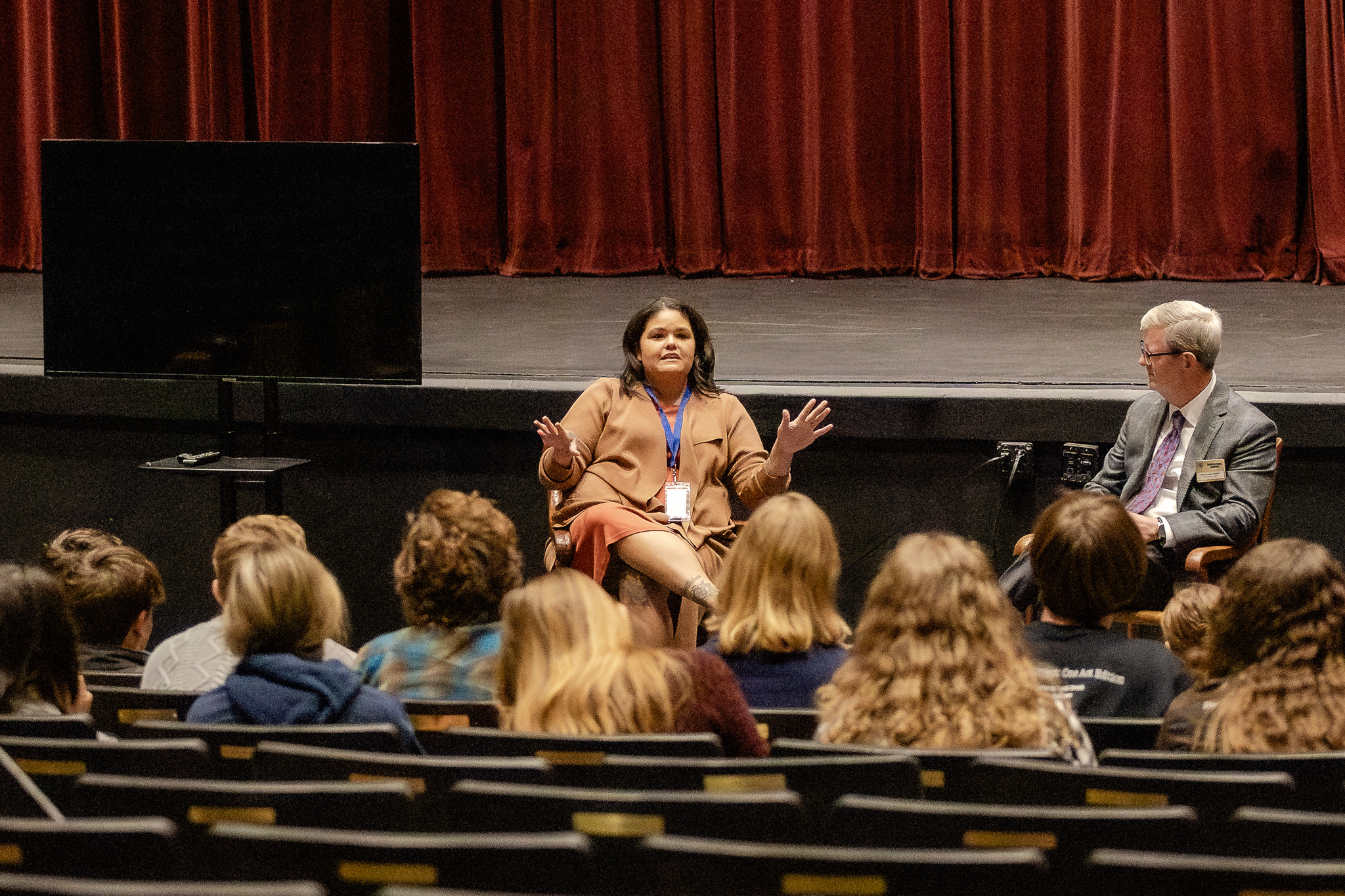
Mechelle Hankerson of WHRO Public Media discusses the current landscape of local news and election coverage with HRA’s seniors at the 2025 Election Symposium
Hampton Roads Academy strives to prepare students for excellence in higher education, but we are no less committed to helping them successfully navigate the challenges they will face beyond a college classroom. In their lives after graduation, HRA students will take on few roles more important than that of citizens.
On Tuesday, October 21, HRA’s inaugural Election Symposium offered our seniors the unique opportunity to hear from three individuals with a deep understanding of the electoral process and the nature of representation at the state level.
The event kicked off in the Svein J. Lassen Auditorium with a conversation with Dr. Rebecca Bromley-Trujillo, director of the Wason Center at Christopher Newport University. Later in the program, the students were joined by Mechelle Hankerson, news director at WHRO Public Media, as well as a member of the Virginia House of Delegates who is up for reelection this year: Amanda Batten, a Republican who represents York and James City Counties and serves as House Minority Caucus chair. Delegate Marcia Price, a Democrat who represents Newport News and Hampton, was originally scheduled to appear but could not attend due to a last-minute conflict.
The wide-ranging symposium, organized and moderated by Upper School government teacher and Associate Director of College Counseling Christopher Hailey, allowed the invited speakers to share their expertise on the political process as it specifically impacts Virginians. Topics of discussion included campaigning for office, the role of delegates in serving constituents, potential changes to state elections, and the role of local media and state-level public opinion polling during election cycles.
Senior Nancy Arena ’26, whose eighteenth birthday falls just a few weeks after the voter registration deadline, found the symposium to be immensely valuable. She noted that the opportunity to gain “one-on-one” access to a local delegate deepened her insight into the realities of state government and elevated her enthusiasm to cast a ballot in the near future.
A Timely Learning Opportunity
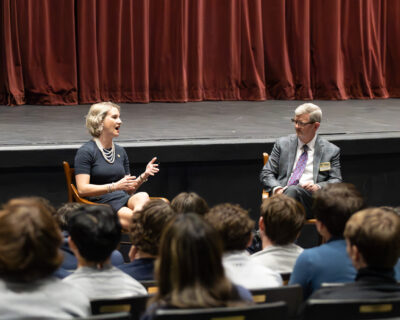
Delegate Amanda Batten speaks with Upper School government teacher and Associate Director of College Counseling Christopher Hailey during the Election Symposium
With elections for the governor and for delegates across the Commonwealth just two weeks away, the symposium could not have taken place at a more critical moment. “Students—all of us, really—are less tuned in to state elections,” Hailey said. “We should all have good information about the electoral process [and] the people representing us.”
Though most twelfth graders are not yet old enough to vote in 2025, they represent the next cohort of Navigators who will apply what they have learned at HRA to inform their choices at the polls. With a holistic understanding of elections, the vast array of players involved, and the responsibilities of officials selected by the voters, our students will be well-equipped to evaluate political messaging and make decisions that align with their priorities and values, rather than defer instinctively to partisan loyalties.
In an era of intense political polarization, Hailey strove to turn down the temperature by inviting Delegate Batten to explain the work she does on behalf of her constituents every day.
State legislators, Hailey acknowledged, “certainly have their ideological bents.” However, he said, “they are close to their constituents, both geographically and in terms of their ability to contact” voters because “they represent 80,000 people and not 800,000 people.”
Having met one of their representatives face-to-face, Hailey hopes, students will not so easily slip into a “generalized cynicism about politics” that leads many citizens to dismiss all politicians as “crooks.”
“These are real people doing real jobs,” he said. “They’re there to serve.”
“Linkage Institutions”
Beyond obtaining a fuller understanding of their elected officials, students gained insight into the many structures beyond campaigns that shape citizens’ relationship with the electoral process.
In his government classes, Hailey explained, he devotes significant time to the “linkage institutions—parties, media (including polling), interest groups—that connect voters to politics.” With half the guests at the Election Symposium representing such institutions, the event provided a concrete picture of how they operate and face unique challenges at the state level.
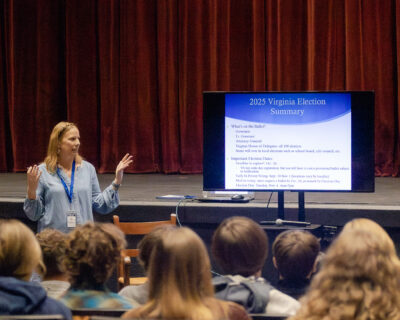
Dr. Rebecca Bromley-Trujillo walks students through the methodologies of public opinion polling at the state level
CNU’s Rebecca Bromley-Trujillo, a political scientist whose research reflects the Wason Center’s focus on the relationship between public opinion and policymaking, provided a process-oriented presentation on how pollsters go about conducting meaningful public opinion research. Such data are often lacking for local races due to the difficulty of obtaining a representative sample out of an already small constituency. As Dr. Brompley-Trujillo explained, however, polling organizations like the Wason Center can conduct reliable state-level polls with samples of just 800 respondents by randomly sampling registered voters, filtering results through a likely-voter model based on recent election participation, and taking the time to ensure that the population polled is demographically representative of Virginians as a whole.
Still, as Dr. Bromley-Trujillo stressed to the students, “surveys are telling you a moment in time. … That can and does fluctuate over the course of an election.”
“Polling is information,” she said. “Voting is what matters, though.”
WHRO’s Mechelle Hankerson built on this discussion by noting how the news media similarly face distinct challenges in covering local and state-level elections. Recent federal budget cuts for public media organizations like WHRO have only exacerbated long-term struggles, such as the decreasing number of local outlets that must determine how to use limited resources to present useful information to markets containing multiple constituencies.
Despite these difficulties, Hankerson explained, newsrooms like hers have one major advantage. “Political reporting—the way we traditionally think of it—is just not useful. We need to focus more on policy instead of politics,” she said. “At the local level, you can really dig into policy and who that affects. … We’re really focused on thinking about it from a community standpoint.”
Future Cycles
With the success of this year’s lively Election Symposium, Hailey looks forward to organizing similar events in future election years. This sort of program, he suggested, would be most interesting to students in off-years, such as 2027, when there will be neither federal campaigns nor a gubernatorial contest to help draw voters into local elections.
“I think that the most important time to get kids tapped into the electoral process is when fewer people typically are paying attention,” he said.
By all indications, HRA’s symposia will have a significant role to play in energizing the students who will soon help to decide local as well as nationwide races.
Gage Beach ’26, who confessed that he had not kept up with the upcoming gubernatorial contest as much as he would have liked, found this forum for discussing the political process eye-opening. Having learned more about pollsters’ methodologies and “the inner workings of the House of Delegates and the State Senate” than he thought he could within just a few hours, Beach is excited for the part he and his classmates will play in elections after graduating from HRA.