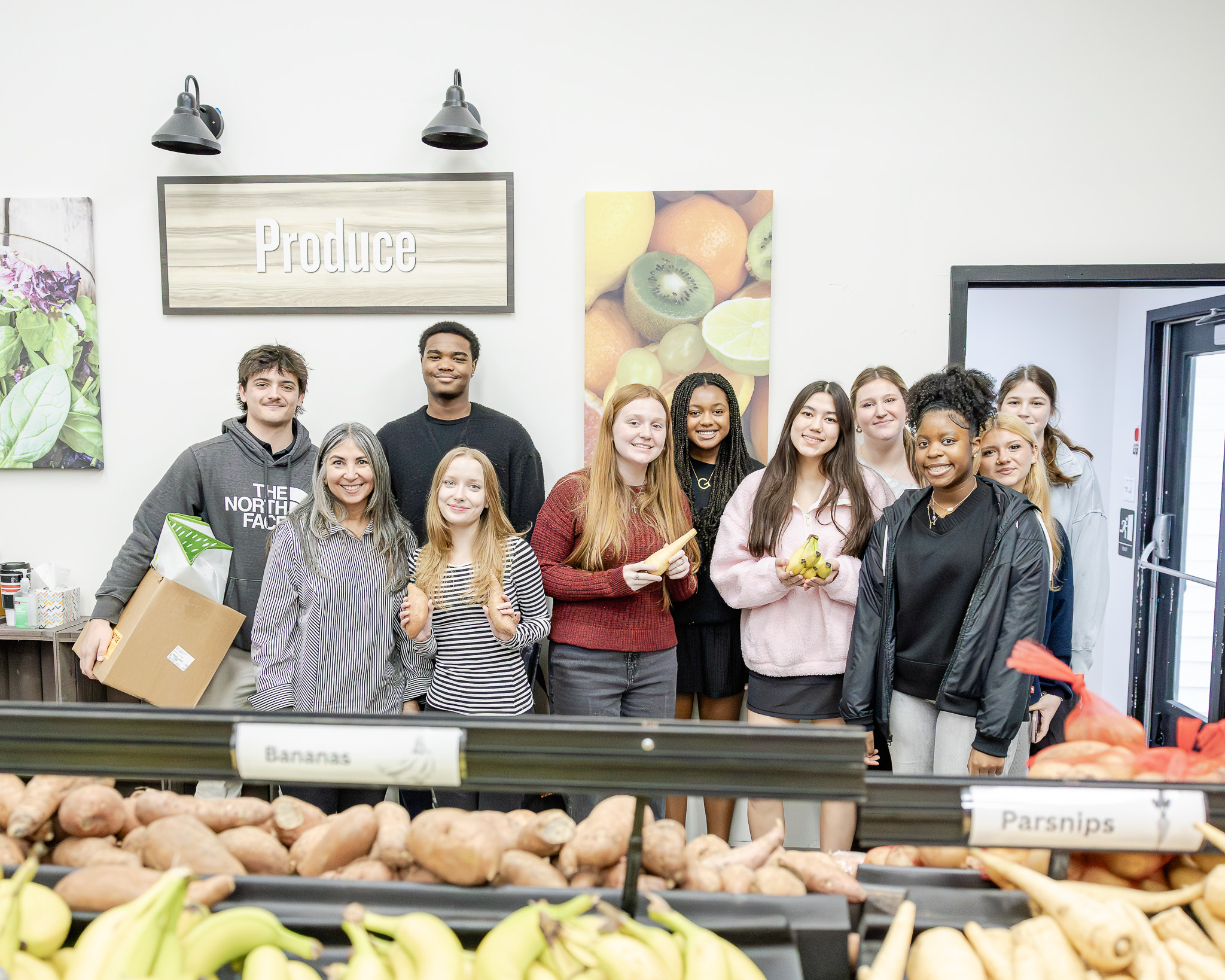
Dr. Maribel Gendreau (second from left) with her anatomy and physiology class at THRIVE Peninsula food pantry
With cutting-edge facilities right on its campus, Hampton Roads Academy is committed to using its resources not only to provide an unmatched learning experience for its students, but also to benefit the community at large.
This winter, Upper School science teacher Dr. Maribel Gendreau’s anatomy and physiology class exemplified this wider impact by partnering with THRIVE Peninsula food pantry in Newport News to supply local families with fresh produce cultivated in HRA’s own Martha H. Patten Hydroponics Lab and STEAM Classroom. The two-month-long advocacy project culminated on Thursday, February 26, with a visit to THRIVE Peninsula, where the students delivered the vegetables they had grown and spent the afternoon volunteering in the food pantry.
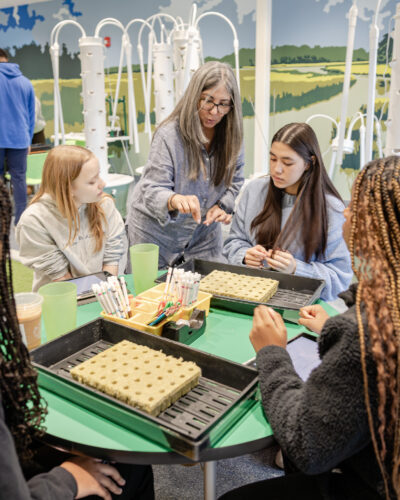
Gendreau guides her students as they seed leafy greens for their winter 2026 advocacy project
Throughout January and February, as Gendreau’s eleventh and twelfth graders maintained their plants and tracked their growth, they gained hands-on insight into how food is produced and affects our bodies while also learning what food insecurity looks like in their community. A quiet epidemic, food insecurity affects about one in nine individuals in Hampton Roads. The crisis is especially pronounced in the winter months, when food pantries, unequipped with indoor hydroponic growing towers, often struggle to provide fresh produce.
“What excites me most about this project is the chance for our students to give back to the community and really understand that there are families who don’t always know where their next meal will come from,” Gendreau said. “Growing leafy greens to donate to a local pantry lets them take what they’ve learned and actually make a difference,” in the process “building cooking skills, teamwork, and a better understanding of how food impacts health and community.”
Hands-On Learning with a Broader Impact
The anatomy and physiology class’ collaboration with THRIVE Peninsula is part of a year-long curriculum that centers the intersections of biochemistry, diet, and society.
Throughout the fall semester, Gendreau’s students learned about food, nutrition, and human health through such practical activities as growing kale in desktop hydroponic units to make kale chips, cultivating peppers and cilantro to prepare fresh salsa, and exploring the benefits of tea and other foods and beverages rich in antioxidants and vitamins.
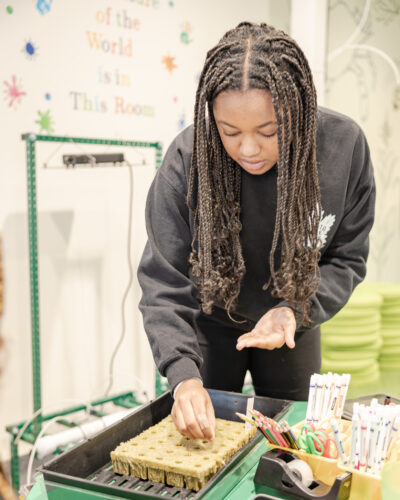
Senior Grace Lee ’26 plants seeds to provide nutritious produce to the community
Support for experiential learning throughout the food and nutrition unit has come from Pilot Light, a nonprofit organization that empowers teachers to bring food education into the classroom and thereby inspire students to become informed citizens. As a member of Pilot Light’s 2025-2026 Food Education Fellowship cohort, Gendreau has received funding for materials and food for weekly hands-on lessons that take advantage of the unparalleled resources available in HRA’s hydroponics laboratory. Her active involvement in this selective professional development opportunity has been a boon to both her students and HRA’s community-engaged mission.
On January 7, just after winter break, Gendreau’s class launched their advocacy project as a way to apply their skills and knowledge beyond the walls of the Academy. Split into five groups of two, each responsible for 28 plants in a hydroponic growing tower, the students tracked the progress of such greens as kale, arugula, butter lettuce, and sweet crisp lettuce for more than seven weeks. In order to ensure that they would produce healthy and delicious produce for families visiting the food pantry, they watered the plants every other day and adjusted the pH and electrical conductivity (a measure of nutrient concentration in the water) biweekly.
This meticulous process, senior and aspiring nutrition and dietetics major Grace Lee ’26 explained, “has taught me that the solution to this crisis is not simply providing more food, but higher-quality, nutritionally sound food. By growing our own food in the hydroponics lab, we are actively attempting to close the nutritional gap in our community.”
Access to nourishing produce, Lee stressed, “is a right, not a luxury.”
Combining STEM with Service
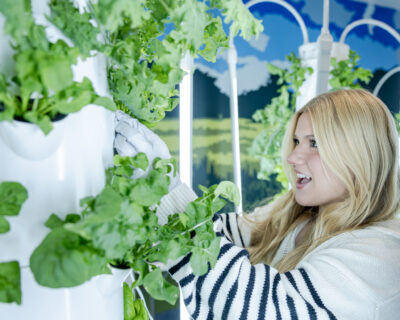
Junior Faith Gregory ’27 harvests vegetables to deliver to the food pantry
By teaming up with THRIVE Peninsula, HRA’s anatomy and physiology students will ensure that every family in Hampton Roads can enjoy that right.
Junior Caroline Short ’27 was especially excited to partner with THRIVE this semester, having volunteered for the organization several times since the summer before her sophomore year and collaborated with them on a food drive through the American Heart Association Club. “One thing I love about THRIVE is that they have a garden connected to the building that supplies them with fresh produce during spring and summer,” she said. “However, during winter, many of the plants can no longer survive.”
With its state-of-the-art hydroponics laboratory, Short noted, HRA is uniquely positioned to remedy this deficit and provide leafy greens rich in essential vitamins and minerals even during the coldest months of the year.
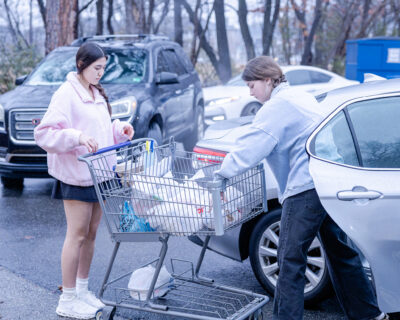
Juniors Ashlyn Davis ’27 and Daphne Ambrosino ’27 help local families obtain groceries while volunteering at THRIVE Peninsula
On February 26, the students witnessed the impact of their efforts first-hand when they delivered their vegetables to the food pantry. The day before, they had harvested the produce they had tended for weeks, weighed it, and separated it into bundles to bring to THRIVE Peninsula. Then, after school hours, they volunteered their time to help families obtain nutritious groceries, including their own leafy greens.
For Gendreau and her class, the gratitude of their neighbors was the greatest reward.
“Through our unique take on ‘farm to table,’” Lee said, “we learned that our resources and skills are not just for our benefit, but are powerful tools that we can use to strengthen and bring our community together.”
“Let’s be honest,” Gendreau added—“everything just tastes better when it’s made to share with others.”