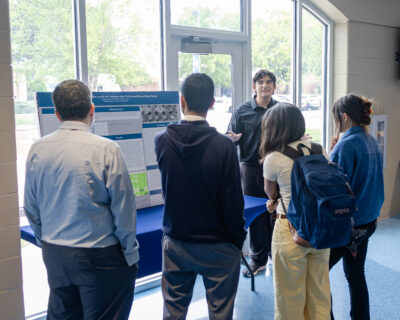
Teachers and fellow students learn about Upper School researchers’ projects at the fifth annual HRA Research Symposium
During the afternoon of Wednesday, April 29, Upper School students and faculty members at Hampton Roads Academy gathered in the Spencer Commons to deepen their knowledge of cutting-edge science and celebrate seven hardworking Navigators’ projects at the fifth annual HRA Research Symposium.
The exciting event shone a spotlight on research conducted by the six students in Upper School science teacher Dr. Maribel Gendreau’s Honors Research Methods class—Abigail Adams ’28, Alana Barnhart ’28, Logan Jones ’28, Lydia Jones ’28, Eleni Sarantakos ’26, and Sophia Vassilakos ’26—along with sophomore Henry Kaplow ’28, who completed an independent study experience with Gendreau this year. Featured projects covered an array of fascinating and timely topics, from combatting environmental microplastic pollution to examining antibiotic resistance with an eye toward medical and agricultural applications.
Displaying high-quality posters and electronic visual aids covering their guiding questions, experimental methods, and key findings, the student researchers fielded challenging but supportive questions from their teachers and peers as they circulated through the Symposium. The event was a much-anticipated “chance for all of us to get together and appreciate each other’s talents,” said Assistant Head of School and Director of Upper School Ben Rous.
One of the most rewarding aspects of the Symposium, according to Rous, was observing attendees’ admiration for the exceptional work of their peers. Standing in front of an audience and sharing one’s original research is a vulnerable experience, he noted, and it contributes immensely to building students’ confidence. “After it, the presenters walk a little taller, chests out a little more,” Rous said.
Beyond the benefits students reap on the day of the event, projects presented at the HRA Research Symposium often serve as a springboard to further achievements. This year alone, Kaplow (with support from the Hampton Roads Academy Independent Research Award) and 2024-2025 Research Methods students Indira Hartke ’27 and Connor Muse ’27 have all qualified for the Virginia Junior Academy of Science (VJAS) Symposium at Hampden-Sydney College, where they will present their papers before a panel of judges on May 2 for a chance to earn competitive scholarships. This honor is a testament to the many opportunities for meaningful independent research that HRA offers its students, allowing them to hone crucial skills in problem-solving, communication, and more for college and beyond.
Practical Applications of STEM Education
The HRA Research Symposium represents an evolution of the Upper School’s former requirement for every student to complete a senior project. This open-ended assignment could take the form of an array of enriching endeavors, from independent scientific research to writing a novel. While there was undeniable value in inviting seniors to explore individual interests through a capstone project, Rous explained, the HRA faculty sought to reimagine this experience to prioritize opportunities for greater depth in a student’s chosen field.
For the STEM-inclined, this meant allowing students, well before twelfth grade, to “get used to doing the work of serious science, which is producing and presenting original research,” the Upper School director said.
Gendreau designed the Honors Research Methods course, culminating in the Symposium, to provide this exposure. The curriculum guides students through experimental design and the creation, execution, and presentation of their own research-based projects, making novel contributions to their fields of interest. The following fall, students are eligible to pursue a BACE (Biotechnology Aptitude and Competency Exam) certification, equipping them with the skills and credentials needed to work professionally in the biotech industry. In this way, Research Methods not only allows students to generate original scientific work, but also, like the REACH (Real-world Experience and Academic Choice) Initiative, provides an opportunity for practical applications of knowledge within the curriculum at HRA. This year, Indira Hartke and senior Lexi Trudeau ’26 seized this opportunity and earned BACE certification.
Student projects at HRA have laid a foundation for several promising careers in scientific research. The Upper School science hallway is lined with award-winning posters presented at the VJAS Symposium and the National Association of Biology Teachers Course-Embedded Student Research (CESR) competition as well as HRA’s own Research Symposium. Navigators who have achieved such distinctions in their Upper School years have regularly continued their research at the university level.
“Difference-Makers” for College-Bound Students
As Rous explained, sharing a project at the HRA Research Symposium is an invaluable experience for students because college preparation is about far more than tackling academically rigorous coursework. “It’s being comfortable in all the different realms that college and beyond include,” he said. “Our graduates should be ready for every eventuality.”
Most directly, preparing for and presenting at the Symposium simulates professional engagement in an academic discipline. “Our students are the experts,” Rous said. “They get to experience what it’s like to author a scientific study and present that material.”
In the process, students not only increase their scientific knowledge and learn research skills, but also gain a sense of whether a career in research is the right fit for them. Rous stressed that it is normal not to know exactly what one’s future path will be by the age of 18, “but I don’t think it’s bad to get to college with a clarified sense of your interests and passions.”
Regardless of the major and career a student chooses, the Symposium helps Upper Schoolers develop—and model for their peers—a host of essential life skills. In addition to communicating ideas at a high level in writing, graphics, and speech, participants practice complex problem-solving as they pursue their projects from hypothesis to conclusion, along with vetting sources, an indispensable ability for all adults in the age of AI.
Through research, students also learn how to seek out and partner with a mentor on a substantial project, one of the hallmarks of a meaningful college experience. HRA’s goal, Rous said, is to introduce spaces for such collaboration during students’ Upper School years, so that the “difference-makers” that will set them apart from their peers in college are not new discoveries, but rather familiar habits.
Exploring New Directions
As the presenters at this year’s HRA Research Symposium universally attested, working on their respective projects under Gendreau’s mentorship not only enabled them to generate new knowledge about their research topics, but also helped give shape to their future plans. Conducting experiments at the frontier of a variety of subfields, they had the profoundly rewarding experience of producing findings that promise to advance biology, medicine, and environmental science.
Lydia Jones ’28: “Comparing the Antimicrobial Effects of Antibiotics vs. Plant Extracts”
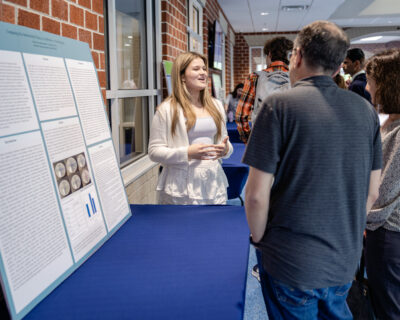
Lydia Jones ’28 explains her research on plant-based alternatives to antibiotics
Inspired by the growing problem of antibiotic pollution in the environment, which is causing bacteria to become increasingly resistant to these vital drugs, sophomore Lydia Jones investigated the antimicrobial properties of plants as an alternative to antibiotics. Through a standard laboratory technique known as the Kirby-Bauer disk diffusion test, she compared the effectiveness of eucalyptus, ivy leaf extract, and tea tree oil to that of familiar antibiotics amoxicillin, clarythromycin, and tobramycin against a bacterium commonly found in the respiratory system. Tobramycin proved most effective, but, intriguingly, Jones found eucalyptus to have slightly greater antibacterial effects than amoxicillin.
Through this study, Jones said, she “learned how to write scientifically and how to be confident in presenting [her] research.” Having achieved results with potentially weighty implications for pharmaceutical science, she is more certain than ever that she will continue pursuing research once she reaches college.
Alana Barnhart ’28: “The Consequences of Stimulants and Their Effects on Energy Output”
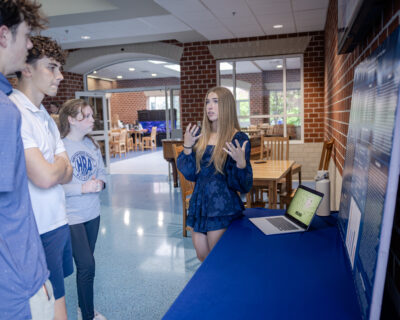
Alana Barnhart ’28 discusses findings that may make her fellow Upper Schoolers reconsider their relationship with caffeine
As a student at a rigorous college-preparatory school, Alana Barnhart has witnessed first-hand how young people frequently turn to coffee for a lift as they work to balance academics and multiple co-curricular activities. In order to gain a deeper understanding of the relative harms and benefits of stimulants like caffeine, the sophomore decided to undertake an experiment to compare these substances’ effects on users’ long-term energy levels. Barnhart administered a fixed concentration of a range of stimulants to different groups of single-celled organisms of the genus Tetrahymena, commonly used in biomedical research, then visually studied changes in their behavior over time as they passed through an observation area. With the assistance of video analysis software, she determined that caffeine resulted in the greatest decrease in energy, followed by nicotine and sugar.
Though this was a new area of research for Barnhart, her project produced a significant insight: while caffeine and other common stimulants provide a clear boost in the short term, they ultimately have a detrimental impact on users’ energy levels. “The biggest skills I learned through this process have been problem-solving in areas I lack education in and learning how to work completely independently,” she said. These abilities will be indispensable as Barnhart works toward a future career in neuroscience or health sciences, both research-intensive fields.
Henry Kaplow ’28: “Balancing Fitness: Trade-Offs between Viral Defenses and Antibiotic Resistance”
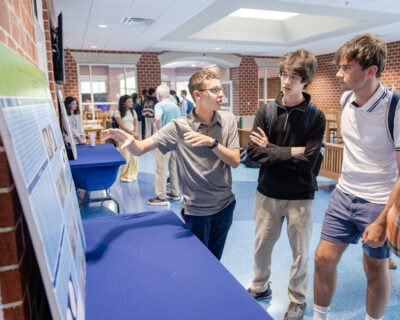
Henry Kaplow ’28 fields questions from his peers during the Symposium
When sophomore Henry Kaplow embarked on an independent study with Gendreau in fall 2025, he knew he was passionate about biology but was not certain how he could make an original contribution within the field. His mentor gave direction to his project when she suggested working with bacteriophages, viruses that infect and replicate inside of bacteria, and taught him the skills he would need to study them. “Without her help, none of it would have been possible,” he said.
Kaplow hypothesized that a bacterium’s survival during a phage attack would result in an evolutionary fitness trade-off, rendering the organism more vulnerable to antibiotics due to damage to efflux pumps through which those drugs are normally expelled. To test this prediction, he exposed several strains of E. coli to the TLS bacteriophage and observed which grew the most, then pipetted each strain into a well plate along with an antibiotic. Studying the bacteria’s proliferation once more, he found that those that had grown the most in the presence of the phage exhibited the least growth when introduced to the antibiotic solution. Strongly suggestive of the evolutionary trade-off the sophomore anticipated, Kaplow’s experiment could lead to further consequential discoveries in research on bacterial sensitivity and resistance to antibiotics, as well as phage-based therapies.
This project, Kaplow said, taught him “how to work in a lab setting and consolidate information in order to share it with a wider audience.” Having impressed his teachers and peers at the HRA Research Symposium and qualified for the upcoming VJAS Symposium, he has undeniably succeeded in both areas. Like his classmates, he has found that his research experience has only increased his enthusiasm for his chosen field, reaffirming his plan to major in biology in college.