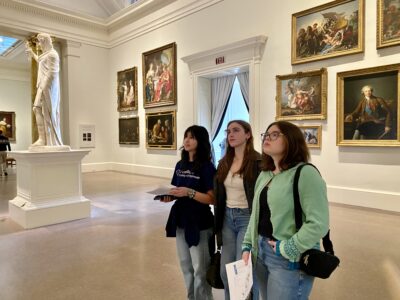
Seniors Nancy Arena ’26, Carys Casper ’26, and Khloe Jobson ’26 take in historic works of art at the VMFA
Hampton Roads Academy embraces the ideals of a liberal arts education, providing students with both broad and meaningful exposure to a diverse range of disciplines. The goal of this approach is not merely to equip students to quote Shakespeare and evaluate integrals. Rather, the Academy’s well-rounded curriculum challenges students to think critically and draw connections between topics to arrive at deeper insights—an ability that will serve them well both in college and throughout their lives.
HRA’s soon-to-graduate twelfth graders spent a full day practicing this crucial skill on Thursday, March 19, during the fifth annual senior field trip to the Virginia Museum of Fine Arts (VMFA). Featuring more than 50,000 works from throughout history and across the globe, this world-class art museum, conveniently located just up the road in Richmond, provided a perfect environment not only to admire breathtaking paintings, sculptures, ceramics, and more, but also to use art as a lens for exploring subjects ranging from history to mathematics.
As in past years, in organizing the trip, AP Literature teacher and Dean of Student Life Laurie Hager made an effort to invite Upper School faculty members from a variety of disciplinary backgrounds to facilitate this experience.
Among them were two veteran chaperones: Upper School counselor and psychology teacher Elizabeth Rous, who explored cognitive phenomena through Impressionist paintings, and English Department Chair Scott George, who discussed mythology with students in the ancient world gallery. New to the trip were math teacher Farica Erwin, who highlighted the mathematics behind Renaissance artwork; visual arts teacher Jack Westervelt, who tackled the intermingling of Eastern and Western cultural traditions in the East Asian galleries; and Director of Theatre Kate Goddin, who used the VMFA’s collection of Fabergé eggs to open up conversations about Russian history and contemporary drama.
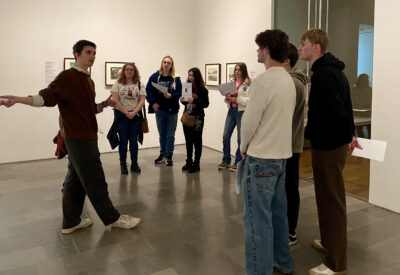
Middle and Upper School visual arts teacher Jack Westervelt challenges students to consider how works on display at the museum reflect the meeting and intermingling of cultures throughout world history
During their visit, the students freely moved between the chaperones’ stations, along the way completing a hunt for literary motifs in works of art that reflected their readings from throughout the year.
This “interdisciplinary juggernaut,” Hager explained, provided “a platform for different [teachers] to bring in their expertise and their ideas—and for students also to bring in their experiences and be able to perceive fresh inspiration by looking at art in a different way.”
“Out in the world, being able to synthesize information will be vital to being a lifelong learner and will enrich their lives,” Westervelt added. “I’m very grateful to have the opportunity to be a part of that.”
A Nexus of Interdisciplinarity
When Hager initiated the tradition of bringing the senior class to the VMFA in 2022, she was drawing on a deep background in interdisciplinary education.
For a number of years prior to joining the faculty at HRA, she taught for the summer Virginia Governor’s School for the Humanities at the University of Richmond, where cross-disciplinary dialogue between students focused on disparate topics, from history and journalism to visual art and theatre, was an integral facet of the curriculum. In previous roles, she also taught AP European History and AP World History, as well as the strongly interdisciplinary IB Theory of Knowledge course. Since pivoting to teaching English at HRA, she has made a point of incorporating elements of her prior disciplinary foci to challenge students to consider the historical context, the musical soundscape, and the popular culture of the eras in which literary works were produced.
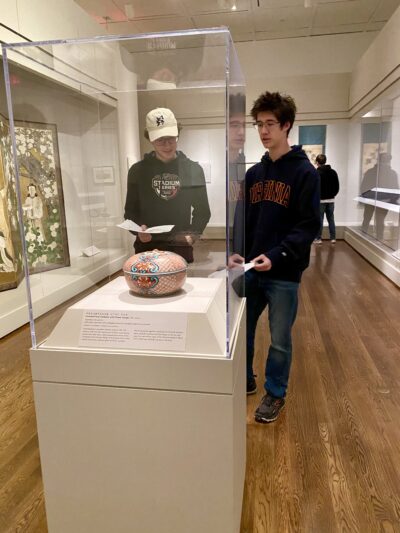
Cam Hall ’26 and Ares Marvell-Nguyen ’26 study a glazed ceramic vessel from eighteenth-century Japan
The VMFA, Hager noted, is perfectly designed to facilitate similar connections between subjects that are too often siloed from one another. Boasting extraordinary collections spanning the European Renaissance, the ancient world, twentieth-century modernism, and rich Asian and African art traditions, all presented with “top-notch” interpretation and arranged in a space that is manageable within a day, the museum naturally invites visitors to consider links between a variety of periods, movements, and cultures across all continents.
Throughout the year, Hager has helped students develop the skills they would eventually apply on the field trip. Asking seniors to examine works of art from throughout world history, she has challenged them to articulate how these images visually mirror the themes and characterization they have encountered in linguistic form in the works they have read.
“This is what I’m asking them to do when we get to the museum,” she said. “Make these broader connections. Make these stronger links. Find meaning. Don’t be intimidated by art. Don’t be intimidated by literature. You bring something fresh and new to the experience based on your own experiences.”
As an instructor who works with twelfth graders every day, Hager is confident that her students are ready for this challenge each spring. “One of the wonderful things about being a teacher of seniors is that I get to walk with them through this final stage of their high school experience,” she observed. “We reflect back frequently on the ways in which their knowledge and their expertise and their interests can play into their interpretation of literature within the context of the class, but we can also extend this beyond the classroom.”
According to the Dean of Student Life, applying what one has learned in a new setting like a museum is valuable practice for taking ownership of new experiences in college and in one’s career—and the key to finding meaning and connection in each phase of life.
The World Reflected in Art
During the trip, students were presented with a list of literary motifs, harkening back to works they had encountered this year in their AP Literature and comparative literature classes, for which Hager and George tasked them with hunting throughout the museum. Subjects included a forest scene reminiscent of A Midsummer Night’s Dream, a work symbolizing the sort of control wielded by Nurse Ratched in One Flew Over the Cuckoo’s Nest, and a piece that thematically echoes absurdist fiction. There was no one work students were to identify for each theme. Rather, the goal was for them to provide an evidence-based justification for each of the connections they had drawn.
As they navigated the galleries, the students encountered and engaged in intellectual boundary-bridging activities with their faculty chaperones, whom Hager described as “pivotal in making this annual trip such a meaningful experience for our senior class.”
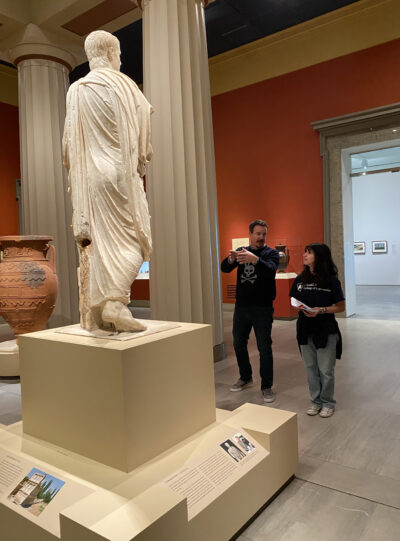
English Department Chair Scott George and Nancy Arena ’26 discuss a statue of the Roman Emperor Caligula in the ancient world gallery
George, for example, explored mythological stories reflected in works in the VMFA’s ancient art collections. His goal, as he explained, was not to dwell on the particularities of millennia-old cultures, but rather to highlight universal themes with which thinkers and artists have grappled across time.
“I like to focus on how ‘we’—as in humanity—express ourselves, because we’re all asking and trying to answer the same questions, no matter what era we live in,” George said.
Westervelt similarly strove to cross chasms of time and space during his workshop in the East Asian galleries. Centering creative expression, he asked students to observe and meditate on a piece of art and compose a haiku. To guide the seniors’ reflections during this activity, he drew their attention to such works as an eleventh-century Chinese bodhisattva and eighteenth-century pottery from Joseon-period Korea to discuss the differences between Eastern and Western artistic and philosophical traditions and the eventual “meeting” of the two through trade and the emergence of composite styles like Dutch Delftware and Art Deco. The art teacher connected these changes to the modern phenomenon of globalization, inspiring students to consider how the Internet has allowed for an intermingling of cultures and artforms on an unprecedented scale.
Just as Westervelt drew on East Asian pieces to explore a larger history of cultural exchange, Goddin leaned into her love of storytelling by using the VMFA’s priceless Fabergé eggs as an entry point for telling the story of their former owners, Russia’s ill-fated royal family, the Romanovs. Focusing on the dramatic tale of Anna Anderson, the imposter who claimed to be the princess Anastasia, having escaped execution by the Bolsheviks, the Director of Theatre explained how art could provide a window into a gripping story that lives on through film and television adaptations and the Broadway musical Anastasia.
Unexpected Connections
The day’s presentations demonstrated that one cannot fully understand a work of art without contemplating subjects often treated as wholly separate from creative expression.
One of the clearest illustrations of this idea was Erwin’s presentation in the Renaissance gallery. This year’s trip marked the first time that the Math Department had been included in the VMFA field trip, and Erwin, certified to teach both mathematics and art, seized the opportunity to explain “how those worlds intersect.” Addressing such topics as perspective and composition, she challenged students to identify the math underlying the construction of Renaissance masterpieces and noted how these precisely crafted works reflect a movement to explain the world scientifically in the fifteenth and sixteenth centuries.
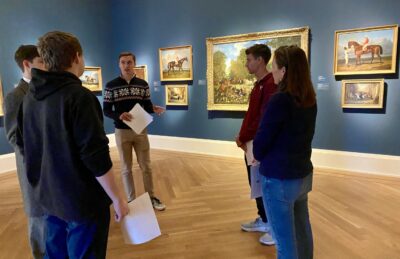
Upper School counselor and psychology teacher Elizabeth Rous asks students to examine their subjective experience of paintings through the lens of perceptual grouping principles
Rous took a similarly surprising tack when she referred to paintings by such artists as Claude Monet, Pierre-Auguste Renoir, and Eugène Boudin to illustrate the Gestalt theory of perception in psychology. Rous explained how the Impressionists implicitly took into account five principles of perceptual grouping, which she outlined in a brochure, in order to convey messages and emotions through their works. As she explained to the students, “We use these grouping principles throughout our lives—not just in art galleries, but while watching a football game, at a performance in the theatre, listening to music, and even when shopping on Amazon.”
As students began to grasp the connections between century-old artwork and the incredible complexity of human psychology and everyday experience, Rous said, “The ‘a-ha’ moments are so cool to witness!”
Making Memories before Graduation
Every year, according to Hager, the VMFA field trip makes for an unforgettable day for the graduating seniors. As she noted, this tradition marks “one of the rare times that they all get to come together as a class to have an experience that’s external to the building.”
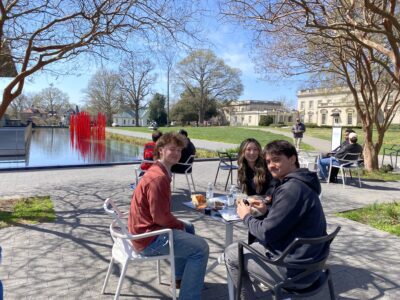
Students enjoy lunch—and reflect on connections they made in the galleries—in the VMFA’s Robin Sculpture Garden
The experience was made more meaningful by the freedom and trust the faculty chaperones extended to the students as a testament to their growth as they prepare to begin their next chapter. Their teachers allowed them to explore the galleries independently, confident that they would interact respectfully with other museumgoers and with the works on display. Inviting the students to dress in jeans and college sweatshirts, Hager hoped their fellow museum patrons would view them not as high school students on a field trip, but rather as young adults, perhaps university students who had simply taken a morning to visit the VMFA.
Hager’s favorite part of the day, she remarked, was sitting on the grass with the students in the museum’s Robin Sculpture Garden, where they enjoyed boxed lunches prepared by Chef Uwe Schluszas and reflected on everything they had encountered in the galleries. As she interacted with the seniors, she was delighted by their surprise at their teachers’ depth of knowledge about topics entirely apart from the focus of their courses.
“It’s not so much the art itself,” she said. “It’s that they’re coming to a new meaning and a new appreciation by listening to the expertise of the faculty members and being challenged to think about art in a new way.”
“Connections are everywhere if we’re willing to look for them,” Goddin observed. “We have to stay curious and be open to taking in new information.”