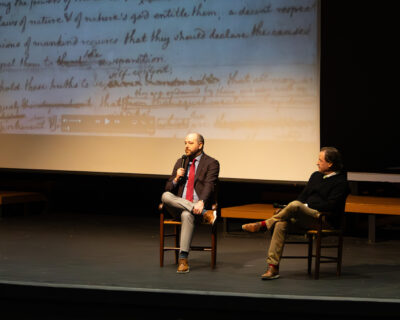
HRA alumnus and filmmaker David Schmidt ’05 discusses his documentary series The American Revolution with the Upper School student body and a familiar face from his time at the Academy, Assistant Head of School and Director of Upper School Ben Rous
Among Hampton Roads Academy’s greatest assets is a network of accomplished alumni who are always excited to return to campus and serve as a resource for students.
On Tuesday, February 10, the Navigator community was reminded of the power of an HRA education and our graduates’ eagerness to give back when award-winning documentary filmmaker David Schmidt ’05 visited his alma mater. Meeting with Lower, Middle, and Upper School students, Schmidt shared excerpts from his latest critically acclaimed docuseries, The American Revolution (2025), which he produced and co-directed with Sarah Botstein and Ken Burns. By sharing and discussing portions of this monumental 12-hour, six-part project, Schmidt helped Navigators across all three divisions think more deeply about their country’s founding as the 250th anniversary of independence approaches, while also introducing them to his craft as a visual storyteller.
The American Revolution marks the latest in a string of impressive collaborations between Schmidt and Burns, America’s most distinguished living documentarian. Having graduated from Dartmouth College with a degree in history in 2009, Schmidt began working with Florentine Films, Burns’ production company, as a researcher, apprentice editor, and script supervisor for The Roosevelts (2014). He subsequently won the Jane Mercer Footage Researcher of the Year award for his work on The Vietnam War (2017) and went on to produce the two-part biography Benjamin Franklin (2022) with Burns.
Schmidt’s, Burns’, and Botstein’s much-anticipated series on the Revolution represents not only the culmination of nearly ten years of preparation, but also a moving full-circle moment for the HRA graduate, who has been captivated by the founding era since his childhood in the Historic Triangle. It was at HRA that Schmidt discovered his lifelong love of historical storytelling, and he hoped, in coming back to the school, that he might help younger Navigators discover the sort of passion that launched his career.
“For a student,” Schmidt said, “I’d want them to know that there are different possible forms of storytelling, especially long-form storytelling.”
Beyond this, he explained, “I don’t want to prescribe any takeaways,” aside from the timeless lesson he has drawn from spending a decade immersed in the history of the nation’s founding: “It takes human effort to accomplish some good in the world.”
Memorable Foundations
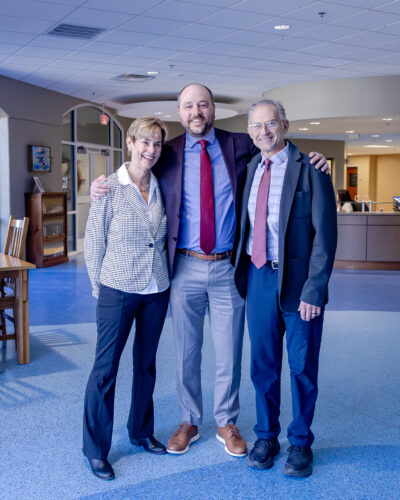
A warm reunion: Schmidt reconnects with two of his former teachers from his time at HRA, Interim Director of Middle School Karen Gillespie and Director of Alumni Relations Tommy Yevak ’83
Early American history has been woven into Schmidt’s life for about as long as he can remember. In his youth, he spent summers working at Colonial Williamsburg, where he returned for a “Behind the Scenes” presentation on The American Revolution after his visit to HRA, and later on the archaeological dig at Historic Jamestowne.
Still, as Schmidt recalled, it was in the classroom at HRA that he truly came to appreciate what a rich story American history is. The Academy’s exceptional history faculty brought the past to life for Schmidt, none more than the late, great Larry Cunningham, whom he had as a teacher four times between eighth grade and his senior year. In Cunningham’s classes, Schmidt not only gained a fund of knowledge upon which he has drawn throughout his career, but also began to view sharing the country’s story as a calling—one to which he has devoted his entire working life.
“To see a child who developed a passion when they were here as a student and then see that transfer into their profession is profound,” said Director of Lower School Susanne Swain ’78, who helmed the Middle School during Schmidt’s time at HRA. “It reminds you of the daily impact we have on students’ lives.”
Interim Director of Middle School Karen Gillespie, who taught Schmidt Spanish in his junior and senior years, was especially excited to reconnect with her former student, the last in a family of five siblings who all passed through her classroom. She fondly remembers “his wry humor and easygoing nature,” his talent in both theatre and athletics, and the T-shirt his family gifted her upon his graduation, reading, “I Survived the Schmidts.”
“I am beyond appreciative of his generosity of time, speaking to students from each division as well as to the documentary film class, and hope that all of the students—and in particular our seventh and eighth graders who are studying the American story and how it began—will be inspired by his remarkable film,” Gillespie said.
Exploring American History through the Art of Film
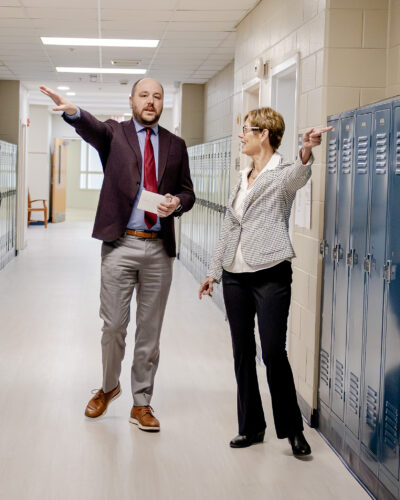
Gillespie walks Schmidt through both new and familiar corners of HRA, including his old locker
Schmidt’s day at HRA started with a tour of a campus that had transformed dramatically in the more than two decades since his graduation. Gillespie and Director of Alumni Relations Tommy Yevak ’83, another former teacher of Schmidt’s, led him through familiar halls as well as newly added, state-of-the-art facilities, such as the Rona & Erwin Drucker Lower School wing and the Martha H. Patten Hydroponics Lab and STEAM Classroom.
Following lunch with the school’s leadership team in another new space, the Mary and Larry Pope Dining Hall, Schmidt met HRA’s fourth graders in the Lower School Commons. For this younger group of students, who have been studying the founding era in their classes, he chose to explore the Revolution through the story of Yorktown native Betsy Ambler (voiced in the documentary by Maya Hawke), who lived through the war as a preteen and teenager. As Schmidt told the students, “She came of age with her country.” Sharing clips from The American Revolution detailing Ambler’s experience of poverty and displacement as her father, a royal tax collector, threw his support behind the Patriot cause and joined the independent Virginia state government, Schmidt helped the Lower Schoolers understand the human dimension of a pivotal moment in the history of the nation and the world.
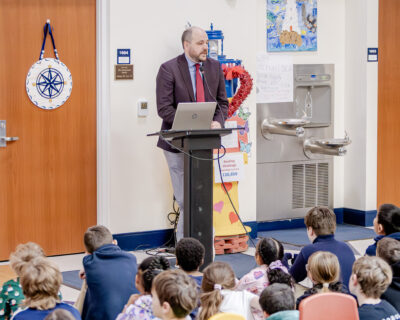
Schmidt explores the human side of the Revolutionary War with HRA’s fourth graders
Addressing the full Upper School student body during their Assembly period, Schmidt played excerpts from the documentary that opened up a more complex conversation about the origins of the United States. He highlighted the perspectives of Native Americans like the Six Nations (Haudenosaunee or Iroquois), the ideological stakes of the Revolution, and the global geopolitical struggle among the nascent United States, Indigenous nations, Great Britain, and a host of European powers. As he wove together these disparate strands, Schmidt challenged the Upper Schoolers to consider how these aspects of the revolutionary story are remembered and, as is too often the case, forgotten in the present.
The alumnus spent the Middle School TEAM period with HRA’s seventh-grade civics and eighth-grade American studies students, with whom he focused on how the United States’ political system and national identity were forged in the crucible of the Revolution. Clips he shared focused on the Declaration of Independence and how it defined the ideals of equality and rule by consent of the governed that guide the American people to this day, as well as the equally radical framework of republican government that the Founders hammered out during the war in state constitutions and the Articles of Confederation and afterward in the U.S. Constitution and Bill of Rights. Schmidt pushed the students to recognize that the society and government with which they are familiar were not inevitable, but rather emerged from considerable debate among the Founders and represent an ongoing experiment.
Storied Pasts and Creative Paths
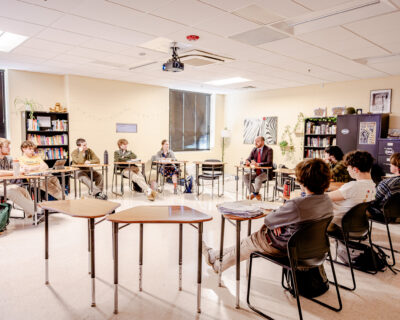
Schmidt answers questions about The American Revolution and his career path in Upper School English teacher Colette Kunkel’s documentary film class
Schmidt fielded questions in each session about his career path and work as a documentarian, but his craft took center stage when he visited the Upper School course “Unfiltered: Exploring Documentary Film,” taught by the English Department’s Colette Kunkel, who has an extensive background in documentary filmmaking herself.
Playing a portion of the docuseries on the 1778 Battle of Monmouth, Schmidt showcased for students the variety of techniques and artistic choices through which he and his colleagues brought their story to life on screen, from the framing device of an artfully filmed solar eclipse and the use of animated maps to the intercutting of historical portraits and drone footage of modern battlefield reenactments. Underscoring the practical and technical side of filmmaking as much as history itself, this last presentation of the day helped students imagine careers of their own as creative storytellers.
“It’s always really interesting to see someone’s journey,” Kunkel said after hosting Schmidt in her class. “It’s not always a straightforward path, and it’s valuable for students to consider what their majors will be in terms of all the possibilities, instead of the assumed one. To see David, as a history major and linguistics minor, end up working on documentary films is an interesting career path.”
If working on The American Revolution brought Schmidt back to his childhood—mentally as well as physically, in locations like Colonial Williamsburg—then sharing the series with younger Navigators was a testament to what HRA, its teachers, and its alumni could make possible. For Schmidt, the Academy was a springboard for his life’s work. He is proud to play a role in laying a similar foundation for the next generation.