
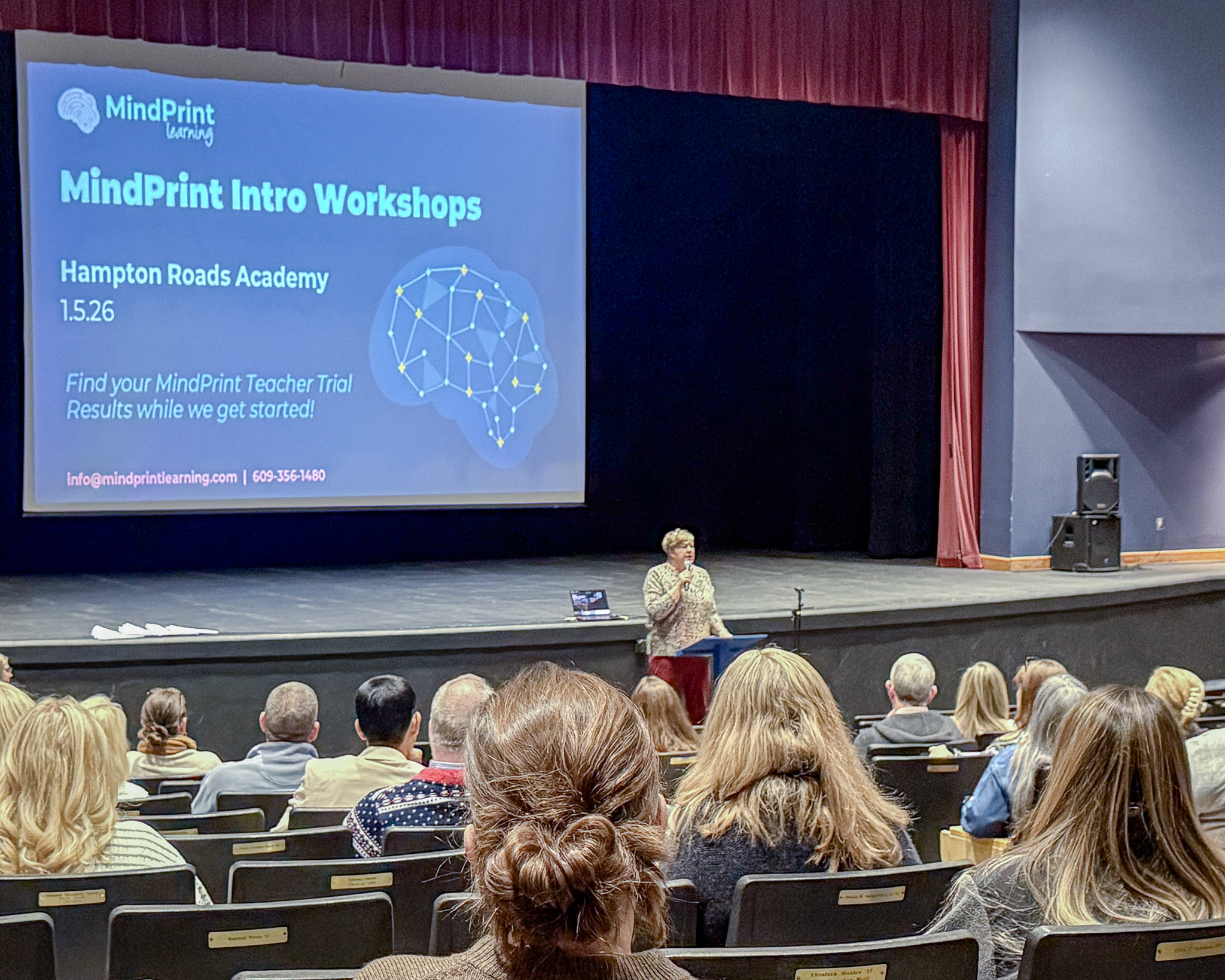
Director of the Student Support Center Lisa Thatcher welcomes teachers to the MindPrint Learning professional development session on January 5
During the spring 2026 semester, Hampton Roads Academy will pilot a new initiative to identify and implement personalized educational solutions catered to each student’s learning style through the online platform MindPrint Learning.
Developed by neuroscientists at the University of Pennsylvania with sponsorship from the National Science Foundation, MindPrint takes a strengths-based approach to academic intervention and acceleration. The platform assesses how each student learns best, pinpoints areas for improvement, and provides tailored strategies and tools to enhance their performance in the classroom and beyond, empowering them to approach their education with a growth mindset.
Spearheading the rollout of MindPrint Learning at HRA is Director of the Student Support Center (SSC) Lisa Thatcher. According to Thatcher, the initiative is a perfect complement to the SSC’s work to meet all students where they are and provide personalized academic resources and skills coaching to guide them toward excellence.
“We will be using MindPrint to help students develop self-awareness of their unique learning strengths, set personalized goals, and discover their best-fit learning strategies so students can take more responsibility for their own learning and success,” Thatcher said.
Head of School Jay Lasley stressed the platform’s incredible potential as a resource at every teacher’s fingertips. “MindPrint is a data-driven tool that will help HRA’s faculty members take the next step in their ongoing mission to provide individual attention and an unmatched learning experience for every Navigator,” he said. “I am thrilled by this opportunity to leverage cutting-edge research for the benefit of our diverse student body.”
Following a professional development session at the beginning of the year to train the entire teaching faculty to help students take advantage of MindPrint Learning, HRA will begin a limited implementation among Upper Schoolers through the SSC in January and February, with the intention to extend the program to all incoming ninth graders in the fall.
A Research-Based Tool to Optimize Teaching and Learning
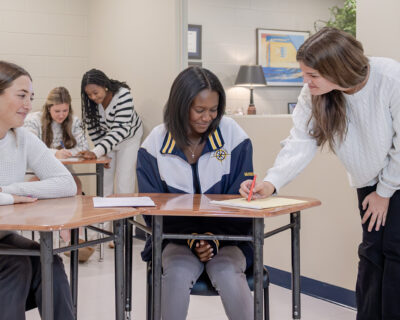
A hub of academic excellence: peer tutors assist their classmates in HRA’s Student Support Center
MindPrint’s program begins with an hour-long assessment designed to be administered every three years to students in Grades 3 through 12. Developed through a National Institutes of Health grant in collaboration with Penn’s Perelman School of Medicine and the Children’s Hospital of Philadelphia, this assessment consists of nine puzzles that serve to identify students’ strengths and needs across three areas:
- Complex reasoning (verbal and abstract reasoning as well as spatial perception),
- Memory (verbal and visual), and
- Executive functions (attention, working memory, flexible thinking, and speed of visual motor skills and processing).
Students can explore their results through a personalized learner profile, enhancing their metacognition and equipping them to develop self-management and self-advocacy skills.
According to Thatcher, when children undergo psychoeducational evaluations, they typically receive reports that recommend limited accommodations, such as extra time on assessments or a quiet testing space—one-size-fits-all solutions that are not targeted to students’ individual needs. MindPrint, by contrast, provides an extensive list of concrete strategies, training videos, and other online tools tailored to each student’s particular strengths and deficits.
When she took the MindPrint assessment herself, Thatcher found the program’s guidance to be “brilliant”: “Be aware of working too fast”—words of caution that resonated with her own observations about herself as “a get-it-done kind of person.” For students who take the assessment, MindPrint will offer similar insights into their academic tendencies and data-informed resources to improve their performance in their classwork and studying.
Equipping Teachers to Empower Students
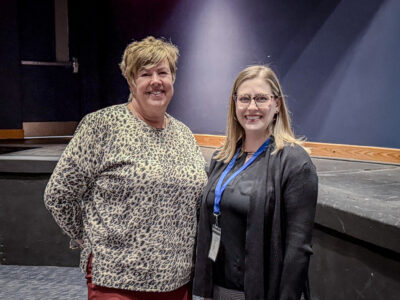
Lisa Thatcher with MindPrint’s Director of Learning Jenny Slobodian
In November and December 2025, all teaching faculty members at HRA took the MindPrint assessment themselves in preparation for a three-hour professional development session on January 5, 2026, led by MindPrint’s Director of Learning Jenny Slobodian. Entitled “The Science of Learning,” the training prepared the faculty, equipped with knowledge of their own strengths as learners, to help students make optimal use of their profiles.
“We want common language around MindPrint,” Thatcher said. “I think it will be so transformative for our students that we can’t have them operating in a vacuum” as they “tap into strategies and their efficient new learning style.”
After the session, Thatcher’s colleagues echoed her enthusiasm regarding the new platform’s potential to enhance the student experience.
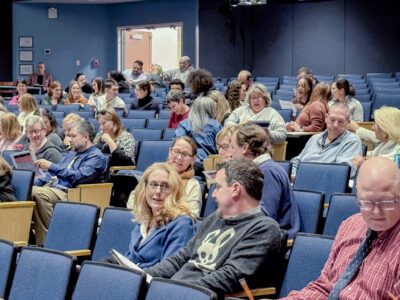
HRA faculty members engage in interactive activities at the MindPrint Learning professional development session
“Having a resource like MindPrint can help us meet our students’ needs in more meaningful ways,” said Middle School history teacher Kerry LiBrando, who plays a hands-on role in her students’ transition from eighth to ninth grade, when they will take the MindPrint assessment. “It was enlightening to think through how I, too, as a learner, approach tasks and information. I am looking forward to seeing how students can be empowered with more information about their learning.”
Upper School science teacher Lauren Oaks agreed. MindPrint, she predicted, will allow teachers to identify more quickly “what works [and] what doesn’t work” for each student. With this knowledge, she said, “we can hopefully have a better game plan going in, rather than waiting until they’re behind.” According to Oaks, this proactive approach will be especially helpful for her students, who are mostly sophomores, as they are challenged to be increasingly independent and take greater responsibility for their own learning in their final Upper School years.
Next Steps
Thatcher will now invite all Upper School students with accommodations for learning differences and all who participate in the SSC’s guided study halls to take the MindPrint assessment this term.
Afterward, she will work one-on-one with the students and their parents on how to translate their results—which may seem overwhelming at first—into actions that the students, their families, their teachers, and their at-home tutors can take to improve their academic performance.
In August, HRA plans to administer the assessment to the incoming ninth-grade class at their Upper School orientation, allowing them to start the academic year with a profile to guide their learning strategies. They will keep themselves on track throughout the year by completing monthly activities during their Advisory periods from MindPrint’s BOOST program, which offers 13 skills-based lessons on such topics as memorization, test-taking, and organization.
With each new freshman class taking the MindPrint assessment, within four years, every Upper Schooler will have a profile to inform their work as a student.
As the Student Support Center expands, the school’s next step will be to offer the assessment to sixth graders, as MindPrint recommends that students evaluate their strengths and areas for improvement once every three years. The SSC will also partner with the Lower School to make MindPrint’s resources available to students in Pre-Kindergarten through Grade 4 and equip their teachers with a “basket of 500 strategies” that they can implement in their classes.
Knowledge of their struggles, their strengths, and how to play to them will empower students at all levels to take ownership of their learning throughout their college-preparatory experience at HRA. This ability, Thatcher emphasized, will set students on a path to success, not only in school, but also as they are challenged to hone new skills and adapt to new challenges in every phase of their lives.