
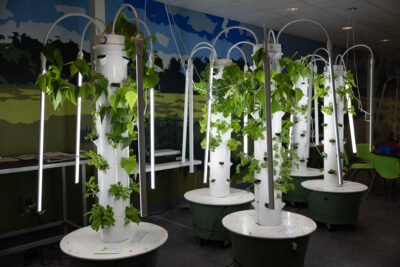
With its 11 vertical growing towers, the Martha H. Patten Hydroponics Lab and STEAM Classroom will provide students with unmatched opportunities for hands-on learning and experiments with real-world applications in the agricultural sciences
With the start of the 2025-2026 academic year, Hampton Roads Academy has officially unveiled the reimagined Martha H. Patten Hydroponics Lab and STEAM Classroom. Complete with 11 vertical growing towers and other agricultural equipment, educational and visually stunning murals, and a diverse array of instructional materials, this cutting-edge facility will provide unparalleled learning opportunities for students across all three of HRA’s divisions.
Named for the late wife of former HRA trustee Donald N. Patten, who sponsored a year-long renovation, the laboratory will reinforce the Academy’s classroom curricula with hands-on activities, introduce students to scientific career opportunities in the agricultural sector, and invite Navigators to play an active role in supplying fresh, locally grown produce for the nutritious meals Chef Uwe Schluszas and Sous Chef Jesse Rowe prepare each day in the Mary and Larry Pope Dining Hall.
“We are thrilled to relaunch our hydroponics laboratory with an expanded curriculum that foregrounds experiential learning and discovery,” said Head of School Jay Lasley. “Connecting science, sustainability, and real-world applications, this innovative resource on our campus will ensure that HRA students can continue to grow, explore, and lead in an environment that lets their curiosity flourish.”
A Collaboration Integrating the Sciences and the Arts
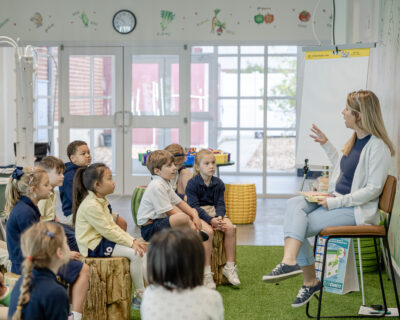
First-grade teacher Staci Lanier teaches her students about agriculture in the immerse environment of the Hydroponics STEAM Classroom
HRA has taken pride in its hydroponics laboratory and the educational possibilities it has promised since it first opened in 2019. However, when he visited the Academy last year, Patten became convinced that this unique, 1,000-square-foot space—then a largely empty room apart from the growing towers—could contribute far more to the school than just lettuce for the dining hall. With a generous gift, Patten launched an ambitious project to upgrade the lab and its curriculum, ensuring the entire school benefits.
In fall 2024, Lasley tapped Upper School science teacher Dr. Maribel Gendreau to spearhead the effort to unlock the laboratory’s full potential. Coincidentally, the previous spring, Gendreau had initiated a dialogue with then-chair of the Fine Arts Department Jennifer Clemons about ways to transition from STEM to STEAM by integrating the arts with a science, technology, mathematics, and engineering curriculum at HRA.
“Artists bring a different perspective into science,” Gendreau said. Scientists’ minds, she explained, tend to be “straight and factual, but artists’ minds are more open and creative.”
Gendreau and Clemons agreed that the hydroponics lab presented the perfect opportunity to blend the arts and the sciences. When Gendreau pitched her vision to Patten, he enthusiastically approved.
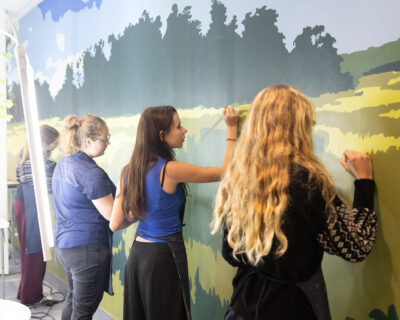
HRA students and National Art Honor Society members put the finishing touches on murals adorning the walls of the laboratory
When the project got underway, artistic creativity was front and center. The transformation of the space began in September 2024 with the painting of the classroom’s two murals. The first, Clemons’ creation, depicts a Chesapeake salt marsh, celebrating this ecosystem’s rich contributions to our regional economy, culture, and traditions. The second, conceived by former HRA art teacher Emily Neuner, showcases the flora, fauna, and crops—trees, corn, insects, birds, mammals, and more—that surround us.
Brought to life with the help of HRA students and National Art Honor Society members, these impressive works will expose students to the beauty of the local environment and the delicate interdependence of all species and natural systems. The murals underscore the Hydroponics STEAM Classroom’s role as a place where creativity and learning can come together and enrich one another.
Constructing a Space Like No Other
By May 2025, the laboratory was ready for equipment installation and reinvention as a space that seamlessly integrates teaching, learning, and experimentation.
Gendreau’s first step in this phase was to disconnect the growing towers from the large chemical tanks formerly mounted on the wall of the laboratory. She then added rollers to the towers’ bases to make them mobile and allow classes to complete multiple distinct hydroponics projects simultaneously. The revamping of the space’s equipment was made possible by the efforts of HRA’s facilities team: Tony Lawrence, Jr., played an indispensable role in helping Gendreau assemble the scientific apparatus, while David Swinney lent invaluable assistance in putting together furniture throughout the room.
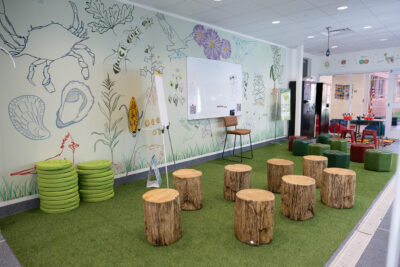
Stunning murals depicting flora, fauna, crops, and the Chesapeake ecosystem combine with a carpet mimicking grass, stools in the shape of tree trunks, and seating cushions resembling leaves to bring the outside into the hydroponics laboratory
Seeking to make the space a fully functional classroom as well as a laboratory, Gendreau designed a seating area with a whiteboard and carpet mimicking grass, extending the murals’ effect of bringing the outdoors into the school. She filled out the classroom with a plethora of resources to facilitate instruction: an easel, informational posters, puzzles and games, books on agriculture, classroom supplies, and curricular materials from Nourish the Future, a national education program that provides science-based curricula for teachers to help them connect students with modern agriculture. Taking advantage of the organization’s efforts to equip educators to bring this important subject into their classrooms, Gendreau had previously trained with Nourish the Future to become a mentor to other instructors.
Nourish the Future, along with hydroponics equipment manufacturer CropKing Inc, provided technical advice and support for the project, including a professional development workshop this past May to prepare teachers in all of HRA’s divisions to make use of the laboratory in their courses and offer the most engaging learning experiences possible.
Opportunities across the Curriculum
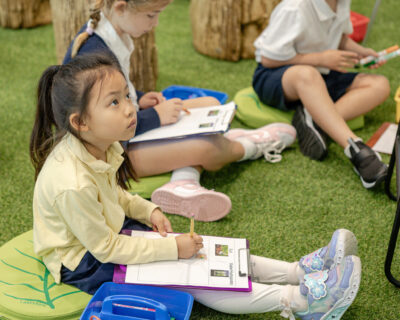
Applied learning in the Hydroponics STEAM Classroom enhances the classroom curriculum in a range of subjects
Gendreau is excited for students to make use of the hydroponics laboratory for both class activities and independent research projects, personalizing their studies and helping them hone their critical thinking skills by designing experiments with real-world applications. She hopes that, in the process, students will not only learn about the food they eat every day, where it comes from, and how it is grown, but also gain an understanding of the economics of farming and agricultural supply chains.
She additionally looks forward to using the laboratory to expose older students to career options in the field of agriculture. This facility presents an opportunity for HRA to shape the scientists who will combat the global food supply challenges of the century ahead.
For HRA’s younger students, the Hydroponics STEAM Classroom will be an equally valuable resource. Lower School science enrichment and computer teacher Tiffany Brakefield explained that she expects the non-traditional learning environment of the new classroom to inspire her students to approach problems in new ways and seek to learn more. She suggested that this unique laboratory would provide a useful extension of the existing science curriculum for early grade levels, which already includes traditional growing activities under lights and outdoors in the Lower School Garden, as well as coverage of aquaponics.
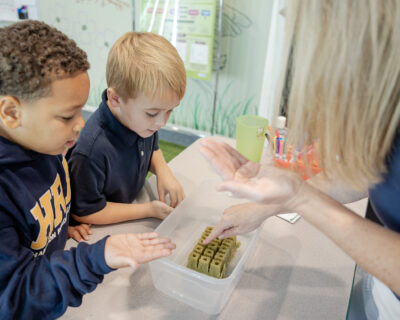
Lower School students gain hands-on lessons in agriculture and sustainability by planting seeds and watching them grow
“Incorporating the hydroponics lab, [students] will learn the growing process and can compare growth cycles, sustainability, and think about the future of our food,” Brakefield said.
Indeed, with three growing towers dedicated to supplying sustainable produce to the dining hall, Navigators of all ages will learn first-hand how the work of cultivation is inseparable from food consumption and diet.
But the Hydroponics STEAM Classroom will have applications far beyond science courses. According to Gendreau, “anything can be taught through agriculture,” including not only science and mathematics, but also such subjects as history and literature, given the centrality of food and farming in human societies and cultures in all eras.
“We are very lucky to have a sponsor like Mr. Patten and to have this space,” Gendreau said. “This is unheard of!”